P1D83 on a Jeep Grand Cherokee isn’t a mystery code, and it isn’t a transmission code either, despite what many generic code-lookup sites imply when they hedge with “manufacturer-specific, could mean several things.”
It’s Jeep’s fault code for Implausible Engine Oil Temperature Signal Received. The PCM is getting an oil temperature reading it doesn’t believe, and it’s flagging the circuit rather than trusting a number that doesn’t add up.
That’s the whole definition: no cylinder-by-cylinder guesswork, no vague multi-system possibility list. One sensor, one circuit, one rationality check that failed. The rest of this comes down to figuring out why the reading looked implausible, and that has a fairly short list of real answers.
How the PCM Actually Catches This
Jeep’s engine control logic doesn’t just read the oil temperature sensor and move on. It runs what’s called a temperature rationality monitor.
After the engine has been off long enough to cool down to a known baseline, the PCM compares several temperature readings against each other: ambient air temperature (AAT), engine coolant temperature (ECT), intake air temperature (IAT), and the engine oil temperature (EOT) sensor.
If the general rationality check between AAT, ECT, and IAT passes, meaning those three agree with each other within a normal range, the PCM then checks the EOT reading against that group.
If the oil temperature value is too far off from what the other sensors say it should be, given how long the engine has been sitting, the rationality check fails and P1D83 sets.
This matters because it tells you something useful right away: the fault isn’t really about “the oil being too hot or too cold.”
It’s about the EOT sensor’s reported number not lining up with what physics says it should be, given the other readings. That’s a signal integrity problem far more often than it’s an actual thermal event.
Common Causes of P1D83 Jeep Grand Cherokee
- Faulty oil temperature sensor: the sensor has failed, drifted out of calibration, or reports open/shorted values.
- Wiring or connector issues: corrosion, a loose or backed-out pin, or chafed insulation between the sensor and the PCM.
- Trapped air after an oil change: a fresh fill, especially if the Jeep was overfilled and then had oil removed, or if the oil was drained and refilled quickly, can produce a temporary reading the PCM can’t reconcile with the other sensors.
- Outdated PCM software: covered directly by a factory bulletin on affected Cherokee models; a reflash resolves it without touching any hardware.
- PCM fault: uncommon, but possible if the sensor and wiring both check out clean and the code is persistent across multiple drive cycles
Jeep’s own service data lists the first three circuit-level causes, a bad sensor, an open or shorted harness, and a poor connection at the sensor, as the standard diagnostic starting points before anything else gets replaced.
The Factory Bulletins You Should Check First
Jeep has actually issued two separate bulletins covering P1D83 on the Cherokee (KL), for different production runs of the 3.2L engine. Which one applies depends on your sales code, not just your model year:
- TSB 18-085-17 (September 19, 2017) covers the 3.2L engine, sales code EHB. It lists P1D83 alongside several other “implausible signal” codes and states plainly that PCM software has been updated to better address this DTC.
- TSB 18-066-20 (August 25, 2020) covers the 3.2L V6 24V VVT engine with ESS, sales code EHK, sold across North America, APAC, EMEA, and LATAM. It lists P1D83 alongside a brake booster pressure sensor code and a steering angle sensor communication code.
Both PDFs above are hosted directly by NHTSA, so you can check the exact language against your VIN’s build sheet rather than take a summary’s word for it.
The fix under either bulletin is a PCM software update, no part replacement. If you’re working on a Cherokee, or a Grand Cherokee sharing this engine family, it’s worth having a shop confirm your sales code and current PCM software level against whichever bulletin applies before anyone recommends a new sensor.
This is exactly the kind of thing a basic code reader will never tell you, and exactly why “P1D83 stored” by itself isn’t enough information to approve a repair.
Even on vehicles outside either bulletin’s specific coverage, the pattern holds: check software currency before assuming a hardware failure.
Where the Sensor Lives
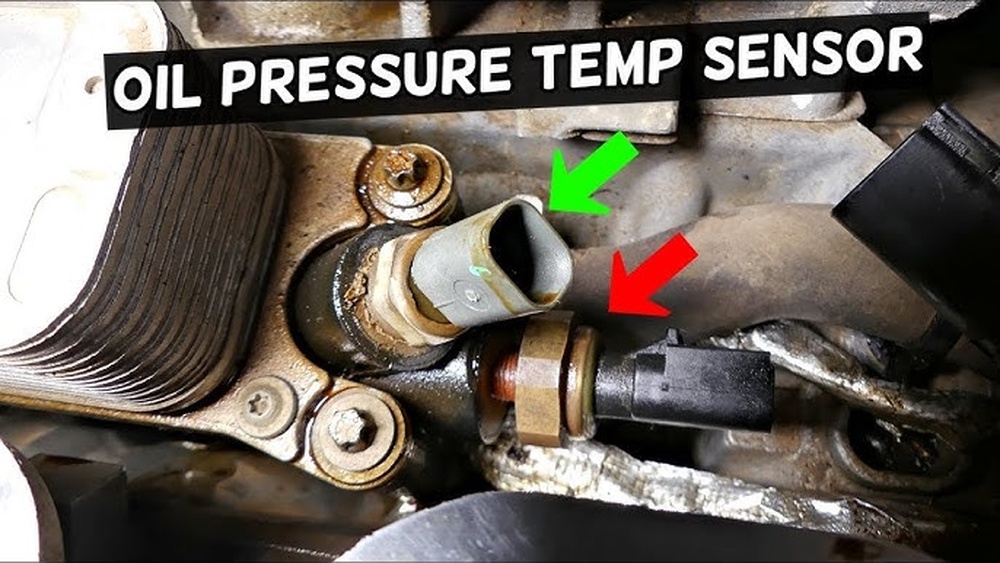
On V6-equipped Grand Cherokee and Cherokee models, the oil temperature sensor sits low on the driver’s side of the engine, just behind the oil filter housing.
There are typically two sensors mounted close together in that area: an upper sensor for oil temperature and a lower one for oil pressure, which is worth knowing before you order a part, since it's easy to grab the wrong one if you're going by
a vague "sensor near the oil filter" description.
Access varies by engine and trim. On some V6 layouts it’s a reasonably straightforward reach-in job; on others, the surrounding accessory brackets and hoses make it a tighter fit that eats more labor time than the part itself would suggest.
If you’re pricing a repair, ask whether the quote already accounts for that access difficulty, because that’s usually where labor estimates diverge between shops.
Symptoms
Most owners see nothing beyond the Check Engine Light. The Jeep drives normally, the gauge cluster oil temperature reading (if your trim shows one) often still looks plausible to the eye, and there’s no loss of power or rough running tied to the code itself.
Some owners report the dash briefly flashing a “Service Electronic Throttle Control” message within a couple of seconds of the code setting, which then clears on its own.
That’s a related module reaction to the fault being logged, not a separate failure; it’s worth noting if it happens, but it isn’t a sign the throttle body itself is bad.
It’s also common for this code to show up right after service work: an oil change, a battery replacement, or a software update for an unrelated recall.
Several owners have reported the code appearing the day after an oil change, particularly when the shop had to remove oil after overfilling, or after a battery event where the vehicle briefly ran on other power sources (relevant on 4xe hybrid models) before the internal combustion engine kicked back on.
None of that is a coincidence. Both scenarios can produce exactly the kind of momentary, out-of-range signal the rationality monitor is designed to catch.
If you’re not sure whether what you’re seeing is normal, it’s worth doing a manual check the way we walk through in how to check oil level on a Jeep Grand Cherokee; comparing the physical reading against what the digital gauge is telling you is a quick way to sanity-check whether the sensor data is actually off.
Is It Serious?
Different sources frame the severity differently, and it’s worth being straight about that instead of picking one and ignoring the other.
Some technical references classify this as a high-priority code worth diagnosing promptly, on the reasoning that inaccurate oil temperature data could theoretically affect how the engine manages oil-related strategies over time.
In practice, the overwhelming majority of real-world reports describe a Jeep that drives completely normally with the code present, sometimes for hundreds of miles, with no other symptoms.
The practical read: don’t ignore it indefinitely, but it’s not a “pull over now” code. If your Jeep is driving normally, it’s reasonable to get it scanned properly and diagnosed on a normal schedule.
If you notice actual related symptoms- poor idle, unusual noise, an oil pressure warning, overheating- treat those symptoms with urgency regardless of which code is stored, because those aren’t things P1D83 by itself typically causes.
P1D83 sometimes appears alongside the generic oil temperature circuit codes P0197 (Engine Oil Temperature Sensor Circuit Low) or P0198 (Engine Oil Temperature Sensor Circuit High).
When these show up together, it reinforces the same diagnosis: a sensor or circuit problem, not something happening deeper in the engine.
If you’re only seeing P1D83 with no companion codes, that leans slightly more toward a rationality/logic-level fault (software, or a borderline signal) rather than an outright sensor failure, though it’s not a certainty either way; live data is what actually settles it.
How to Diagnose It Step by Step
1. Pull the full code and check for a bulletin match. Confirm your engine and drivetrain against TSB 18-066-20. If it applies, ask about current PCM software level before anything else happens.
2. Check live oil temperature data on a capable scan tool. Watch the reading with the engine cold and again after it’s warmed up. You’re looking for a value that’s frozen, jumps erratically, or reads something physically implausible (like an unrealistically high number seconds after a cold start).
3. Compare against the other temperature sensors if your scan tool allows it. Since the PCM’s own logic compares EOT against AAT, ECT, and IAT, doing the same comparison yourself on a scan tool tells you whether the anomaly is isolated to the oil temp circuit or part of a broader sensor disagreement.
4. Inspect the sensor and connector physically. Look at the connector near the oil filter housing for corrosion, a pin that’s backed out, moisture intrusion, or oil contamination inside the connector shell. A visual inspection here catches a meaningful share of these faults before any part gets replaced.
5. Factor in recent service history. An oil change in the last few days is a real clue pointing toward a temporary trapped-air reading rather than a failed part. Clear the code, drive it through a normal cycle, and see whether it returns.
6. Test the circuit electrically before swapping the sensor. A resistance and continuity check on the sensor circuit takes less shop time than replacing the sensor twice because a wiring fault got missed the first time.
7. Confirm the repair. After any fix, reflash, sensor, or wiring repair, clear the code, complete a normal drive cycle, and rescan to confirm it stays clear. If you’re clearing codes manually rather than through a scan tool, our how to reset a Jeep Wrangler guide covers both the pedal-cycle method and the OBD-II scanner method; the same logic applies across Jeep models.
What You Can Check Yourself
You don’t need a shop-grade scanner to gather useful information before deciding on a repair path:
- Note whether the code appeared right after an oil change, battery work, or a software update.
- Check whether the Jeep is driving normally or showing any other symptom.
- Look at the connector near the oil filter housing (driver’s side, low on the engine) for obvious damage or corrosion if you’re comfortable doing so.
- Record the mileage and conditions when the light came on.
- Check your maintenance records for the last oil service date.
If you do have a scan tool capable of reading manufacturer-specific Jeep codes and live sensor data, that’s the single most useful thing you can bring to this diagnosis; a basic generic OBD-II reader will confirm the code exists but won’t show you the live
oil temperature trace that actually points to sensor, wiring, or a genuinely temporary condition.
If you’re shopping for one, our BlueDriver Bluetooth OBD2 scanner review covers a tool that handles this kind of live-data digging well.
Cost to Fix
| Repair | Typical Cost |
|---|---|
| Diagnostic scan and live data check | $80, $150 (about 1 hour labor) |
| PCM software update (if bulletin applies) | Often covered under warranty; otherwise roughly $150, $250 |
| Oil temperature sensor replacement | $80, $220 parts and labor on accessible layouts |
| Wiring or connector repair | $100, $300 |
| Sensor replacement on harder-to-access layouts | Can run higher due to labor time, sometimes $300+ |
These figures assume the diagnosis correctly identifies the cause on the first attempt. Skipping the diagnostic step and guessing at a part is usually what turns a $150 repair into a $400 one, not because the part itself was wrong to check, but because it got checked out of order.
Labor rates vary by region and shop type. Independent shops typically run $80 to $150 per hour; dealerships and metro-area shops are often higher.
If a shop’s quote seems high relative to these ranges, ask specifically whether it reflects extra labor for accessing the sensor on your engine layout, since that’s a legitimate reason for variance.
OEM vs. Aftermarket Sensor
For a sensor this closely tied to PCM logic, sticking with an OEM or a well-reviewed direct-fit replacement is the safer call.
A generic aftermarket sensor with a slightly different resistance curve can produce readings that trip the same rationality monitor all over again, which means paying for a part that doesn’t actually solve the problem.
This isn’t true of every sensor on a vehicle, but for temperature sensors feeding a rationality check specifically, matching factory specs matters more than usual.
Mistakes That Waste Money on This Code
- Replacing the sensor before checking for the TSB. If a software update fixes it, a new sensor won’t.
- Skipping the wiring inspection. A corroded connector can mimic a failed sensor and will make a brand-new sensor throw the same code.
- Assuming it’s transmission-related. It isn’t. Don’t approve transmission diagnostic time based on this code alone.
- Clearing the code repeatedly without addressing the cause. If it keeps coming back, the underlying issue- sensor, wiring, or software- is still there.
- Ignoring recent service history. If the code appeared right after an oil change, that context should shape the diagnosis before parts get ordered.
Can You Still Drive With P1D83?
In most real-world cases, yes. If the Jeep drives normally, isn’t showing any other warning, and P1D83 is the only code stored, it’s reasonable to keep driving and get it diagnosed on a normal schedule rather than an emergency one.
If you notice actual symptoms unrelated to the code appearing on their own, rough idle, oil pressure warnings, overheating, those deserve prompt attention on their own merits.
Preventing a Repeat
- Have the connector near the oil filter housing inspected during routine oil services, especially if you’ve had this code before.
- If your engine falls under TSB 18-066-20, confirm the PCM software update was actually applied, not just recommended.
- Avoid overfilling on oil changes, and let the Jeep sit for a proper cool-down period before assuming a reading is wrong.
- Keep a record of when the code appeared relative to any service work, in case it returns, and a shop needs that history.
P1D83 on Wrangler 4xe and Other Hybrid Models
The 4xe’s hybrid architecture adds a wrinkle worth calling out separately. On a 4xe, the vehicle can run for extended periods in electric-only mode with the internal combustion engine completely off.
When the battery depletes and the ICE kicks back on, the PCM has to reconcile oil temperature data from an engine that’s been sitting cold (or partially warm, depending on how long it was off) against the other temperature sensors in a way a conventional gas engine’s PCM never has to handle.
Owners have reported P1D83 setting within seconds of the ICE restarting after an extended electric-only stretch, sometimes right after service work like an oil change or an unrelated software update.
This lines up with the rationality-check explanation above: the PCM is comparing a fresh EOT reading against other sensors during an atypical warm-up sequence, and if the numbers don’t reconcile fast enough, the code sets even though nothing is mechanically wrong.
If you drive a 4xe and this code appears after a period of electric-only driving, that context is worth mentioning to whoever diagnoses it. It doesn’t rule out a genuine sensor or wiring fault, but it does raise the odds that a drive cycle and a clean scan will tell you more than jumping straight to a parts order.
Why Different Sources Describe This Code Differently
If you’ve searched around and found conflicting explanations for P1D83, there’s a reason. A lot of code-lookup sites pull from generic OBD-II databases that don’t distinguish well between broad, vague framing and the actual manufacturer-defined fault text.
Because the code number starts with a “P1,” some sites default to boilerplate language about “manufacturer-specific, could involve several systems” without ever landing on the specific system Jeep actually defined: the oil temperature sensor circuit and its rationality check against other sensors.
That’s also how you end up with articles that pad the causes list with things like valve body wear, transmission adaptive learning, or internal clutch pack damage, none of which have anything to do with this code.
If a source frames P1D83 as a transmission problem, or hedges on what it actually means without citing the sensor circuit and the rationality monitor specifically, that’s a sign the content was generated without checking Jeep’s actual service documentation or the factory bulletin that covers it.
Quick Reference Glossary
- PCM (Powertrain Control Module): The computer that manages engine and, on some platforms, transmission functions, and the module responsible for setting P1D83.
- EOT (Engine Oil Temperature): The sensor and signal this code is specifically about.
- AAT / ECT / IAT: Ambient Air Temperature, Engine Coolant Temperature, and Intake Air Temperature, the three sensors the PCM cross-checks against EOT during the rationality monitor.
- Rationality monitor: A diagnostic check comparing a sensor’s reading against other related sensors to see if the value makes physical sense, rather than just checking if the sensor is reporting a signal at all.
- TSB (Technical Service Bulletin): A factory-issued repair procedure for a known issue, in this case bulletin 18-066-20 covering the PCM software fix.
- Implausible signal: Jeep’s terminology for a reading that fails the rationality check, not necessarily an open or shorted circuit, just a value that doesn’t reconcile with related sensor data.
Diagnostic Summary Table
| Question | What It Tells You |
|---|---|
| Did the code appear right after an oil change? | Leans toward a temporary trapped-air reading; clear and monitor |
| Does your engine match TSB 18-066-20 (3.2L V6, EHK)? | Check PCM software before replacing parts |
| Is the Jeep driving normally otherwise? | Supports a non-urgent diagnostic timeline |
| Are P0197 or P0198 also stored? | Reinforces a sensor/circuit-level fault |
| Does the connector show corrosion or damage? | Wiring repair may resolve it without a new sensor |
| Is this a 4xe that just came off electric-only driving? | Consider the hybrid warm-up sequence before assuming a hardware fault |
| Has the code returned after a previous “fix”? | The underlying cause- sensor, wiring, or software- likely wasn’t fully addressed |
What to Ask Before Approving Any Repair
If you’re taking this to a shop rather than handling it yourself, a few direct questions will tell you quickly whether they’re diagnosing the actual code or guessing:
- “What’s the full code definition your scanner shows, not just P1D83?”
- “Does my engine and drivetrain fall under TSB 18-066-20, and if so, what’s the current PCM software level?”
- “Did you check the connector and wiring before recommending a sensor?”
- “Was this preceded by an oil change, battery work, or a software update in the last week or two?”
- “What live data did you check to confirm the sensor itself is bad, versus a wiring or software cause?”
A shop that can answer these without hesitation is diagnosing the fault properly. A shop that jumps straight to “you need a new sensor” based on the code alone, without checking the bulletin or the wiring, is guessing, and you’re the one paying for the guess if it’s wrong.
What does P1D83 mean on a Jeep Grand Cherokee?
It means the PCM received an oil temperature signal it couldn’t validate against its other temperature sensor readings, logged as Implausible Engine Oil Temperature Signal Received.
Is P1D83 a transmission code?
No. It’s tied to the engine oil temperature sensor circuit and the PCM’s temperature rationality check, not transmission control.
Can an oil change cause P1D83?
Yes. Trapped air or an inconsistent fill right after service can produce a temporary reading the rationality monitor rejects.
Clearing the code and driving a normal cycle is a reasonable first step in that situation.
Is there a factory fix for this code?
On Cherokee models with the 3.2L V6 (sales code EHK), TSB 18-066-20 calls for a PCM software update. Check whether your vehicle is covered before replacing parts.
Do I need a dealer to fix this?
Not necessarily. Independent shops can diagnose and repair the sensor or wiring.
A dealer is worth checking with first if the TSB applies, since the fix is a software update rather than a part.
Will P1D83 damage my engine if I ignore it?
It’s unlikely to cause damage on its own. It’s still worth resolving properly rather than repeatedly clearing it, since a persistent sensor or wiring fault won’t go away on its own.
Where is the oil temperature sensor located?
On V6 Grand Cherokee and Cherokee models, it’s low on the driver’s side of the engine, just behind the oil filter housing, typically paired with the oil pressure sensor mounted close by.
Can low battery voltage cause this code?
Unstable voltage can affect sensor readings generally, but the documented cause list for P1D83 centers on the sensor, its wiring, and PCM software, checking battery health is reasonable due diligence, not the primary suspect here.
The Bottom Line
P1D83 has a specific, documented definition: an oil temperature signal the PCM couldn’t validate against its other sensors. It’s not a transmission fault, and in most cases it’s not an emergency.
Start with the cheap checks, recent service history, a bulletin match, a look at the connector, before spending money on a sensor, and don’t let anyone diagnose it as something more dramatic than what Jeep’s own service data actually says it is.
If P1D83 wasn’t the code you came here for, we’ve broken down other Grand Cherokee-specific faults the same way; see U0403 00 on the Jeep Grand Cherokee for a transfer case communication example, or Jeep Wrangler check engine light codes for a broader rundown of how these codes are structured.