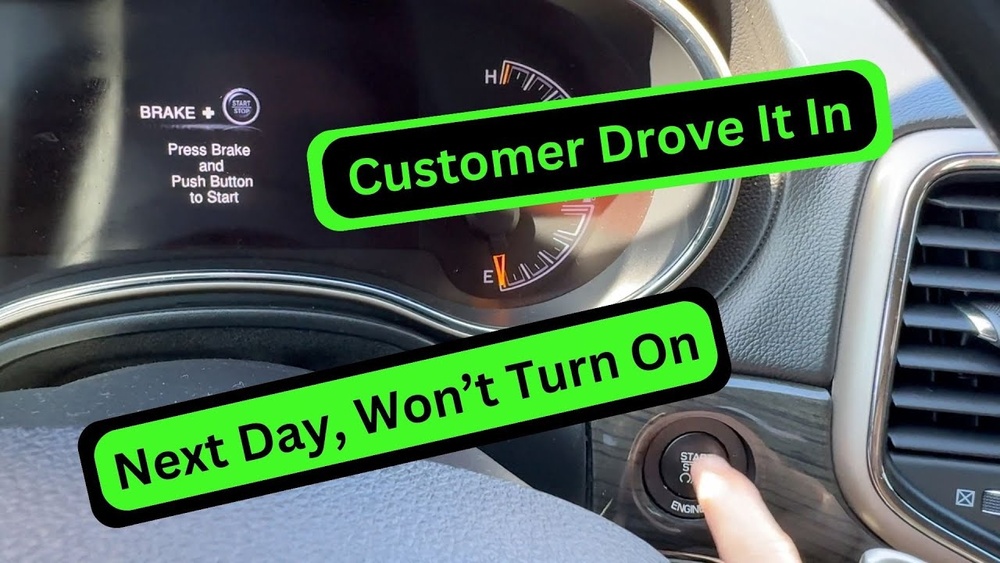
So your dash just threw up the words “stop/start unavailable service stop/start system,” and you’re wondering if something’s actually wrong with your Jeep Cherokee.
Short answer: your Cherokee’s automatic engine shut-off feature switched itself off, and that’s really the whole message. Annoying, sure.Not something that’ll strand you.
Here’s what actually causes it on the Cherokee, which part usually gets blamed, and where to start looking before you hand a shop money for a diagnostic.

Your Cherokee’s Electronic Stop/Start system, or ESS, shuts the engine off when you come to a stop at a light or in traffic, then fires it back up the moment you lift off the brake. It’s there to save fuel, not to keep you safe, so don’t confuse it with something like traction control.
When this message shows up, the ESS module has run into something it doesn’t trust, usually a voltage reading or sensor signal that’s off, so it shuts itself down until whatever’s wrong gets sorted out. You’ll typically notice a small amber icon on the cluster, too, a circled “A” with an exclamation point next to it.
Under the hood, the Body Control Module and Powertrain Control Module are constantly checking a handful of conditions before they’ll allow an Autostop: battery state of charge above roughly 80%, battery temperature within a safe range (typically 20°F to 122°F), engine coolant temperature warmed up,
and no active faults from the IBS, hood switch, or starter circuit.
If any single condition falls outside spec, the system locks itself out and throws this message rather than gambling on a restart. That’s also why the light sometimes disappears and comes back on its own; it’s reacting to whichever condition changed.
If you plug in an OBD-II scanner and pull codes, ESS-related faults on the Cherokee commonly show up as U0100-series communication codes, or manufacturer-specific B-codes tied to the IBS circuit, hood ajar switch, or starter relay circuit.
A basic code reader will often come back clean even with an active fault, since these are frequently stored as manufacturer-enhanced codes.
If you want to catch them yourself instead of paying a shop just to read codes, look for a Bluetooth OBD-II scanner that specifically advertises enhanced or manufacturer-specific code support; a plain generic reader usually won’t cut it here.
A couple of things worth knowing before you go digging further:
- Your engine, transmission, and normal starting still work the same. Only the auto stop/start function is affected.
- You’re fine to keep driving. Nothing about this is a safety issue.
- You’ll notice slightly worse gas mileage without auto stop/start, especially in stop-and-go traffic.
- More often than not, this shows up before a battery dies completely, so treat it as a heads-up rather than an emergency.
This message tends to show up most on 2014 to 2019 Cherokees (the KL generation), and after digging through enough of these, the causes really come down to a short list of repeat offenders.
A Weak or Failing Battery
ESS needs a battery that can handle a lot of restart cycles without breaking a sweat, which is why Cherokees with this feature use an AGM battery instead of a standard flooded one.
A conventional flooded lead-acid battery is only rated for a few hundred deep cycles before it degrades, whereas an AGM battery is built for tens of thousands of shallow cycles, since the engine can restart hundreds of times a day in stop-and-go traffic.
The Cherokee’s factory battery is typically a Group Size 48 or H6, rated between 730 and 800 Cold Cranking Amps, depending on trim and engine. Once capacity drops below roughly 80 to 85% of rated output, the module would rather shut itself off than risk a restart that doesn’t happen.
A resting voltage under 12.4V, checked with a cheap multimeter or a proper 12V battery load tester, is usually the first sign something’s off before ESS even throws the warning. If it does need replacing, stick to a Group 48 / H6 AGM battery built for start-stop use; a standard flooded battery will get you started again, but usually won’t hold up under ESS for long.
A Bad Intelligent Battery Sensor
The IBS clips directly onto the negative battery terminal, between the terminal clamp and the factory ground cable, and constantly feeds voltage, current, and temperature data to the car’s computer over a single-wire connection.
Out of everything on this list, it’s probably the most common cause of this exact message on a Cherokee; it comes up constantly in owner forums and independent shop write-ups alike.
On the Cherokee, the OEM part numbers you’ll see most often are 56029777AA, AB, and AC, with the letter suffix reflecting minor production changes rather than a functional difference.
Corrosion on the connector or a loose ground is often all it takes to set this off, so before spending money on a new sensor, disconnect the battery, pull the IBS connector, and look for white, green, or bluish corrosion buildup.
A shot of electrical contact cleaner and a reseated connector fixes a surprising number of these for a few dollars. If cleaning it doesn’t help, a genuine Mopar IBS sensor is worth the extra cost over an aftermarket one; owners report a noticeably higher repeat-failure rate with generic replacements.
If you do replace the IBS, some Cherokees need a battery relearn performed with a scan tool afterward so the module resyncs with the new sensor’s baseline readings; without it, the fault can linger even with a good sensor installed.
A Faulty Hood Switch
There are actually two hood-related switches on these Cherokees, one for the security system, and a smaller plunger switch specifically checking that the hood is latched before ESS will attempt a restart. Either one going bad, or even just getting misaligned, can trigger this warning with the hood closed properly.
Starter Relay Wear
The relay handling your starter takes a beating under stop/start use, since it’s cycling far more often than on a car without ESS, potentially hundreds of extra starts a week. When it starts to go, the module won’t risk a restart it isn’t confident about, and you get the same message.
On the Cherokee, this usually means relays K1 and K9 in the Power Distribution Center, the fuse and relay box in the engine bay. Both are standard automotive mini relays, cheap enough that some owners just replace both as a pair rather than trying to isolate which one is marginal.
Too Many Short Trips
If most of your driving is quick errands around town, your battery may never get a full charge. A battery sitting below the voltage the ESS system wants will trip the warning even with no actual part failure; it’s just not charged enough.
Extreme Heat or Cold
Very hot or very cold weather can disable auto stop/start on its own, on purpose, since restarting under those conditions puts more strain on the battery. This version usually goes away once the engine’s warmed up.
Recent Battery Service
It’s pretty common to see this pop up right after a battery swap, oil change, or anything else that involves disconnecting the battery. Give it a charge cycle or two before assuming something’s actually broken.
Work down this list, cheapest fixes first, more involved ones later.
| Step | What To Do | Typical Cost |
|---|---|---|
| 1 | Drive 20+ minutes on the highway to fully charge the battery | Free |
| 2 | Get the battery load-tested at a parts store or shop | Free, $20 |
| 3 | Clean the IBS connector on the negative terminal | Free, $15 |
| 4 | Replace the IBS if it’s corroded or bad | $50, $150 (parts) |
| 5 | Check the hood switch and the smaller ESS plunger switch | Free, $40 |
| 6 | Replace the battery with a matched AGM unit if it fails testing | $150, $300 |
| 7 | Have the fault codes scanned at a dealer or shop | $100, $150 |
A few things that’ll save you time here. If the message keeps coming back or won’t clear at all, get it scanned for codes first, rather than guessing; it’ll point you to the battery, IBS, hood switch, or relay instead of you replacing parts one at a time.
Stick to AGM batteries only; a regular lead-acid battery wears out fast under this kind of cycling and will trigger the same warning even when it seems fine otherwise. And after any battery work, give the Cherokee a few hours to sit, then a proper drive, before deciding whether the fix actually worked. The module needs time to re-check itself.
Can You Just Reset It?
Sometimes, yeah. Here’s the basic procedure:
- Turn off the ignition and remove the key, or make sure the fob is out of range on keyless models.
- Open the hood and locate the negative battery terminal.
- Loosen the terminal clamp and disconnect it; this will clear your radio presets, clock, and some infotainment settings.
- Wait 60 to 90 seconds to let the modules fully power down.
- Reconnect the terminal and torque it back down so it’s snug; a loose terminal will just reintroduce the same IBS communication problem you’re trying to rule out.
- Start the engine and let it idle a few minutes, then take a 15 to 20 minute drive to let the ESS module run through its own self-check.
This clears a one-off glitch and forces the module to recheck everything from a clean slate. That’s fine for a fluke, or for a fault that was really just a temporarily low charge.
It won’t do anything for a genuinely bad IBS, hood switch, or relay; the message just comes right back once the car’s back on the road, sometimes within the same drive cycle.
What About Just Disabling It?
Plenty of Cherokee owners eventually get sick of chasing this down and disable ESS for good, either with an aftermarket eliminator module or by having a shop turn it off. That’s a reasonable call once you’ve actually confirmed there’s no real battery or charging fault underneath it.
Worth keeping in mind, though: disabling the feature on a car with a genuine electrical problem just hides the warning, not the problem, and you can still end up with a dead battery down the road. If the Cherokee’s still under warranty, get the real issue diagnosed and fixed rather than covering it up.
Is it safe to drive with this message on?
Yes. It only turns off the auto stop/start feature, everything else about the car works normally.
Why did this show up right after I got a new battery?
The ESS module usually needs a full charge cycle before it trusts a new battery. Drive normally for a day or two before worrying about it.
What exactly is IBS?
The Intelligent Battery Sensor sits on the negative terminal and tracks voltage, current, and temperature in real time. It’s one of the most common reasons for this warning.
Does this mean my battery is dying?
Often, but not always. If the message keeps coming back after a full charge, get the battery load-tested.
Can cold weather trigger this on its own?
Yes, extreme temperatures disable stop/start on purpose to protect the battery, and it typically clears once the engine warms up.
What does it cost to fix?
Depends what’s wrong. Battery testing is usually free, an IBS replacement runs about $50, $150 in parts, and a full AGM battery swap is typically $150, $300 installed.
Will a basic code reader show me the fault behind this message?
Not always. Many ESS faults on the Cherokee are stored as manufacturer-enhanced codes rather than generic OBD-II codes, so a cheap Bluetooth reader may come back clean even with an active fault.
A shop-level scanner or the dealer’s wiTECH tool gives a much more reliable read.
What battery specs does my Cherokee need for ESS to work?
An AGM battery in Group Size 48 or H6, rated roughly 730 to 800 Cold Cranking Amps depending on trim. A standard flooded battery will work for basic starting, but typically won’t sustain ESS reliably and can trigger this warning repeatedly.
Bottom Line
Nine times out of ten, that stop start unavailable service stop start system message on a Cherokee comes down to the battery, the IBS, a hood switch, or the starter relay, and none of them stop you from driving safely. Start cheap: test the battery, check the IBS connector, work your way down the list.
If it keeps coming back after that, a scan tool reading the actual fault codes will save you more time than guessing ever will.
For help tracking down the exact fault code behind this message, check our Jeep diagnostic trouble code library, or see our Jeep Cherokee battery and charging system guide for keeping your AGM battery in good shape.