A Jeep Grand Cherokee Overland 4×4 has always occupied a strange spot in the lineup, not quite the value pick, not quite the flagship, but the trim that off-road-minded buyers gravitate toward because it’s the lowest rung on the ladder with genuinely serious hardware underneath it.
Overland is where Jeep starts bolting on the mechanical bits that separate a Grand Cherokee from a soft-roading crossover, and it does it without the price tag or the extra weight of a fully loaded Summit.
There’s also a timing wrinkle worth knowing up front. Jeep pulled Overland from the lineup for the 2026 model year, then confirmed in June 2026 that it’s coming back for 2027, with the new turbocharged engine and updated hardware.
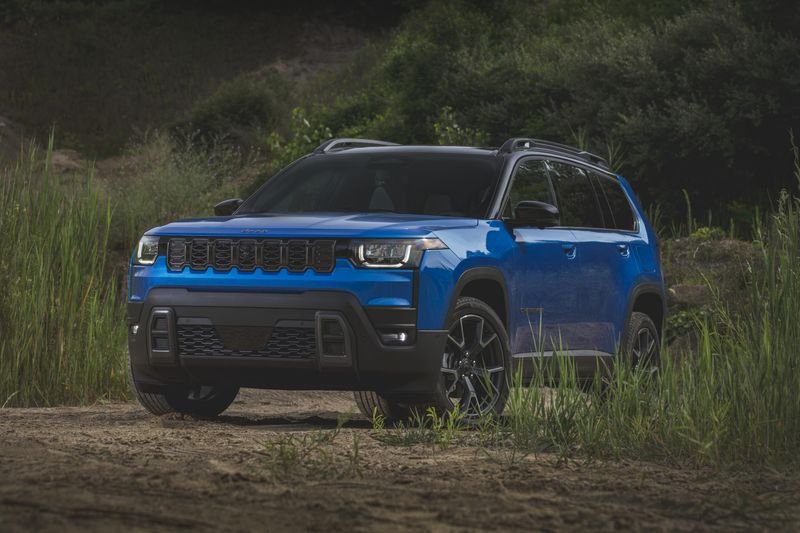
So depending on when you’re reading this, “Overland 4×4” might mean a 2025-or-earlier used vehicle, or a fresh 2027 order.
This guide covers both, because the core identity of the trim, Quadra-Trac II, air suspension, and a mid-pack price that punches above its weight off-road, carries through either way.
What “4×4” Actually Means on the Jeep Grand Cherokee Overland
Shoppers cross-referencing the Jeep Grand Cherokee Overland 4×4 sometimes assume “4×4” is just a checkbox option that adds traction in snow.
On the Overland, it’s more specific than that. The trim pairs with Jeep’s Quadra-Trac II system, a full-time active 4WD setup built around a two-speed transfer case, which is the detail that actually matters.
That second, low-range gear is what turns the Grand Cherokee from “capable in bad weather” into “capable on an actual trail,” giving it the mechanical advantage needed for steep grades, deep mud, or rock crawling at low speed.
This is a step up from the single-speed Quadra-Trac I system offered lower in the lineup, and a step below Quadra-Drive II, which adds an electronic limited-slip rear differential and shows up on some higher trims and off-road-focused variants.
On the Overland, Quadra-Trac II works alongside the Selec-Terrain traction management system, which lets the driver dial between Auto, Sport, Rock, Snow, and Mud/Sand modes, each one adjusting throttle mapping, transmission behavior, and traction control to match the surface.
Engine and Performance
For 2025-and-earlier Overland models, the standard engine is the 3.6-liter Pentastar V6, producing 293 horsepower and 260 lb-ft of torque, paired with an eight-speed automatic.
It’s worth being direct about something a lot of older comparison articles get wrong: the V8 option was dropped from the two-row Grand Cherokee starting with the 2025 model year, so a current-production Overland 4×4 will not come with a Hemi, that engine only survives, briefly, in a handful of other configurations before being phased out entirely.
Fuel economy on the V6 4×4 comes in around 19 mpg city and 26 mpg highway, and towing capacity tops out at 6,200 lbs when properly equipped, regardless of engine.
The returning 2027 Overland changes this picture. According to Jeep’s own announcement, the reintroduced trim pairs Quadra-Trac II and Quadra-Lift air suspension with the 2.0-liter Hurricane 4 Turbo engine, the same 324-horsepower, 332 lb-ft unit introduced on other 2026 Grand Cherokee trims, rather than the outgoing V6.
That’s a meaningful jump in torque and, on paper, should translate to quicker off-the-line response and better real-world towing manners even without a V8 in the picture.
Jeep hasn’t published final fuel economy or towing figures for the 2027 Overland at the time of writing, so treat those as pending until the automaker confirms them closer to launch.
Jeep Grand Cherokee Overland 4×4 Off-Road Capability
The single biggest mechanical advantage of the Overland trim is Quadra-Lift air suspension, and it’s worth understanding what it actually does rather than treating it as a luxury bullet point.
The system lets the Grand Cherokee adjust ride height across five settings, from an aerodynamic, lowered highway mode to a raised off-road mode, using electronic semi-active damping rather than fixed springs.
In its raised setting, an air-suspension-equipped Grand Cherokee achieves a minimum ground clearance of roughly 10.9 inches, up from about 8.4 inches on the standard suspension.
Approach angle improves to around 30.1 degrees with the suspension raised, genuinely competitive territory for a vehicle that spends most of its life doing school runs and highway commutes.
Ramp breakover angle sits around 24 degrees in the raised setting. These aren’t hero numbers next to a dedicated off-roader like a Wrangler, but for a unibody midsize SUV with a genuinely nice interior, they’re strong, and they’re the reason Overland owners can credibly take the vehicle somewhere a Limited or Limited Reserve owner would think twice about.
The suspension isn’t purely about extremes, either. At highway speed, it automatically lowers the vehicle slightly to reduce aerodynamic drag and improve stability, most owners will interact with that feature far more often than the raised off-road setting, even if the off-road capability is what sold them on the trim in the first place.
Interior and Comfort Features
A Jeep Grand Cherokee Overland 4×4 was never meant to feel like a stripped-down trail truck, and it doesn’t. Cabin materials step up noticeably from Limited: Nappa leather seating, a dual-pane panoramic sunroof, and a meaningfully more upscale dashboard and door-panel finish.
Heated front and rear seats are standard, and ventilated front seats typically come with the trim as well, which matters more than it sounds like if you’ve ever gotten into a black-leather seat in July.
Technology-wise, Overland carries the same core infotainment as other mid-and-upper trims, a large touchscreen running Uconnect, Apple CarPlay and Android Auto support, and a stronger available audio system than what you’d get on Limited.
Driver-assistance features like adaptive cruise control and lane-keep assist are typically included or available, positioning Overland as a genuine luxury-adjacent SUV that happens to also be unusually capable off pavement, rather than a stripped-out off-roader with leather bolted on as an afterthought.
Pricing: Used Now vs. Waiting for 2027
If you’re shopping today, a used Jeep Grand Cherokee Overland 4×4 from the 2025 model year is a used or dealer-leftover purchase, generally landing somewhere in the low-to-mid $50,000s depending on mileage, condition, and options, often with meaningful savings off original MSRP if you’re buying from a dealer clearing out remaining inventory.
That’s the practical appeal: most of what makes Summit desirable, at a real discount, with the understanding that you’re buying outside Jeep’s newest warranty cycle.
Jeep hasn't announced pricing for the returning 2027 Overland, but given where it will likely slot between Limited Reserve and Summit in the current lineup structure, expect it to land somewhere in the mid-$50,000s to start, though that's an estimate, not a confirmed figure, and
worth verifying against Jeep's site closer to launch.
The honest tradeoff: buy used now, and you get Quadra-Lift capability with the outgoing V6 at a discount, with a shorter remaining warranty.
Wait for 2027, and you get the new turbo engine, a full factory warranty, and current technology, at a price that hasn’t been set yet and with a wait of unknown length.
Overland 4×4 vs. the Rest of the Lineup
Against Limited Reserve, the current mid-tier trim, Overland’s real advantage is the air suspension and the resulting off-road numbers; Limited Reserve doesn’t offer Quadra-Lift at all.
Against Summit, Overland gives up the massaging seats, four-zone climate, and Active Driving Assist, but keeps the same fundamental 4×4 hardware and air suspension capability for meaningfully less money.
For buyers whose priority is actual trail capability rather than highway comfort features, Overland has historically been the smarter dollar-for-dollar choice, which is likely exactly why Jeep brought it back.
For a full side-by-side of how Limited, Limited Reserve, and Summit compare on price and features, see our Grand Cherokee trim comparison guide.
Does the Jeep Grand Cherokee Overland come with 4×4 standard, or is it optional?
What’s the difference between Quadra-Trac II and Quadra-Trac I?
Does the Grand Cherokee Overland have a V8 engine option?
Is the Overland trim coming back for 2027?
How much ground clearance does the Overland 4×4 have?
The Bottom Line
Overland has always been the trim for buyers who want real off-road hardware without paying flagship money for features they won’t use, and that’s just as true whether you’re eyeing a discounted 2025 model on a dealer lot today or waiting on the 2027 relaunch.
If Quadra-Lift air suspension and genuine trail capability matter more to you than massaging seats and a 19-speaker sound system, Overland remains the smartest dollar-for-dollar pick in the Grand Cherokee lineup, which is exactly the case Jeep seems to be betting on by bringing it back.