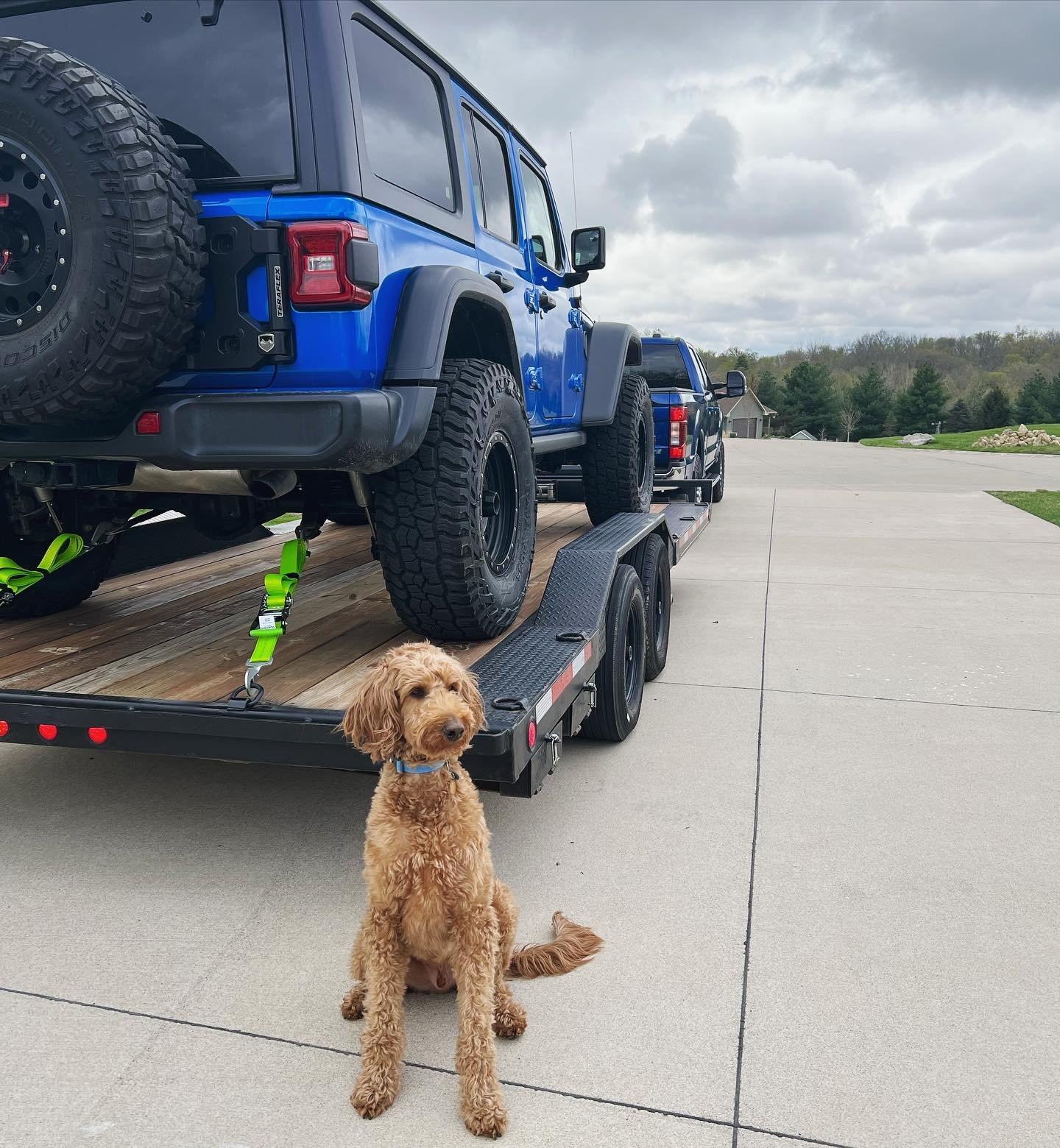
Towing your Jeep on a trailer is a common need for off-road enthusiasts, car haulers, and those moving long distances.
But securing your Jeep safely is more than just a quick tie-down it’s about protecting your vehicle, your trailer, and everyone on the road.
Many people get this wrong, which can lead to accidents, damage, or even fines. Here, you’ll learn the complete process of how to tie down a Jeep on a trailer, including equipment, step-by-step guidance, and expert tips that most beginners miss.
Why Properly Securing Your Jeep Matters
Many overlook the risks of an improperly tied-down Jeep. Sudden stops, sharp turns, or rough roads can shift your vehicle and create dangerous situations.
A single loose strap can let your Jeep move, causing damage to its suspension or frame, or even leading to total loss if it falls off the trailer.
Proper technique is not just about following the law it’s about safety for you and others.
A study from the National Highway Traffic Safety Administration shows that more than 4,000 accidents each year in the US involve unsecured loads. Most of these are preventable with the right knowledge and preparation.
Essential Equipment For Tying Down A Jeep
Before you start, make sure you have the right gear. Not all tie-down equipment is equal, and using the wrong tools can be just as risky as using none at all.
| Equipment | Purpose | What to Look For |
|---|---|---|
| Ratchet Straps | Securing vehicle to trailer | At least 10,000 lbs break strength, 2″ wide minimum |
| Axle Straps | Wrapping around axles/tires | Heavy-duty fabric, protective sleeves |
| D-Rings or E-Tracks | Trailer anchor points | Welded or bolted, rated for vehicle weight |
| Wheel Nets (optional) | Securing tires | Fit Jeep tires, high-tension webbing |
| Gloves | Hand protection | Durable, good grip |
Non-obvious insight: Many people buy standard 2″ ratchet straps from hardware stores, but often these are only rated for 3,000–5,000 lbs. A Jeep Wrangler can weigh 4,000–5,000 lbs, so always check the working load limit on the strap label.
Preparing The Trailer And Jeep
Preparation is key. Loading and tying down without the right setup can make the process harder and less safe.
- Check the trailer rating: Your trailer must be rated for the weight of your Jeep plus any gear inside.
- Inspect the trailer: Look for rust, loose boards, or damaged anchor points.
- Clean the deck: Remove mud, gravel, or oil so the Jeep tires grip the trailer.
- Position the trailer: Use a flat, level surface to prevent the Jeep from rolling during loading.
Expert tip: Mark your trailer deck for wheel placement using tape or paint if you regularly haul the same Jeep. This saves time and ensures the correct position every time.
Loading The Jeep Onto The Trailer
This step is more than just driving up the ramps. Weight distribution is critical for safe towing.
- Drive forward: Line up straight with the ramps. Use a spotter if possible.
- Center the weight: The Jeep’s engine should be slightly forward of the trailer’s axle(s), aiming for about 60% of the load in front of the trailer axles.
- Check parking brake: Once in position, put the Jeep in park (or first gear for manual transmission) and engage the parking brake.
- Chock wheels: Place wheel chocks on both sides of at least one tire to prevent rolling during tie-down.
Common mistake: Placing too much weight at the rear of the trailer causes “trailer sway,” a dangerous fishtailing effect at highway speeds.
Choosing The Right Tie-down Points
Where you attach straps is just as important as how you attach them. The wrong tie-down points can bend parts or damage the Jeep’s suspension.
Best Tie-down Points For A Jeep
- Axles: Most secure, as they are designed to take load.
- Frame tie-down hooks: Found on some models, but not all.
- Tow hooks or D-rings: Only if rated for pulling weight.
Avoid tying down to bumpers, control arms, or body panels. These can bend or break under tension.
Non-obvious insight: Some aftermarket bumpers look strong but are not meant for tie-down. Always check the manufacturer’s rating.
Step-by-step: How To Tie Down A Jeep On A Trailer
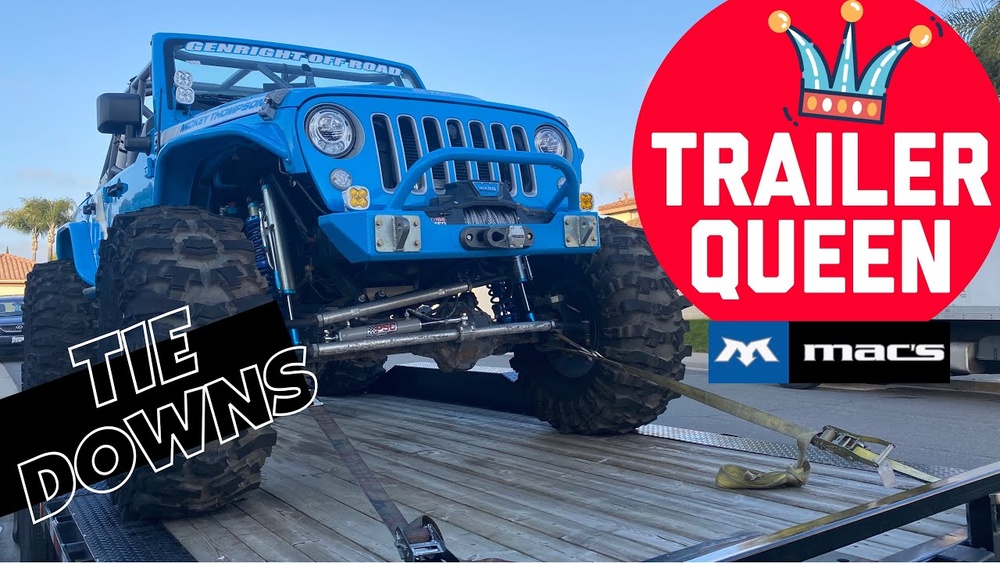
Follow these steps for a secure tie-down, whether you’re using axle straps, wheel nets, or a combination.
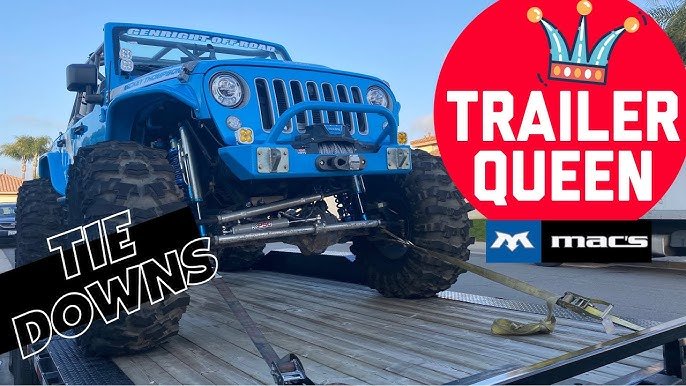
1. Attach Axle Straps
- Loop one axle strap around each axle, near the wheel (not on moving suspension parts).
- Pull the strap tight, making sure it can’t slide along the axle.
- If using wheel nets, slide them over each tire, making sure they fit snugly.
2. Connect Ratchet Straps
- Hook the ratchet strap to the trailer D-ring or E-track.
- Feed the strap through the axle strap D-ring or over the wheel net.
- Pull all slack out of the strap before ratcheting.
3. Tighten Straps
- Use the ratchet mechanism to tighten the strap. It should be taut but not crushing the suspension.
- Repeat for all four corners (two front, two rear).
- Double-check each strap for twists and ensure the hooks are secure.
4. Cross The Straps (if Possible)
- Cross the left strap to the right anchor point and the right strap to the left anchor point, both front and rear.
- This prevents side-to-side movement in turns.
Note: Some trailers or wheel nets are designed for straight (not crossed) tie-downs. Follow the instructions for your equipment.
5. Final Checks
- Shake the Jeep side to side. It should not move more than 1–2 inches.
- Inspect all straps for wear, fraying, or weak stitching.
- Secure excess strap tails so they won’t flap in the wind.
Example: A 2022 Jeep Wrangler Unlimited, weighing 4,400 lbs, should be tied down with four 10,000-lb-rated straps, crossed at each corner, and anchored to welded D-rings.
Comparing Tie-down Methods
There are several ways to secure a Jeep, but which is best for your situation? Here’s a quick comparison.
| Method | Pros | Cons |
|---|---|---|
| Axle Straps | Very secure, fits most Jeeps | More effort, risk of improper placement |
| Wheel Nets | Fast, reduces suspension strain | Must fit tire size exactly |
| Frame Tie-Downs | Quick, easy access points | Not all frames have hooks; risk of bending |
Experience-based tip: For off-road Jeeps with modified suspensions, wheel nets are often best, as they allow the suspension to move slightly without loosening the straps.
Legal And Safety Requirements
Laws for securing vehicles on trailers are strict—and for good reason. Most US states require:
- At least four independent tie-downs (one per corner)
- Straps and anchor points rated for the vehicle’s weight
- No loose or dangling straps
Fines for improper tie-down can range from $150 $1,000, and accidents can result in much higher costs.
Unexpected fact: Some insurance companies will not cover damage from a vehicle that was not properly secured, even if you have full coverage.
Troubleshooting Common Problems
Even experienced haulers run into issues. Here’s how to handle the most common problems:
- Straps keep loosening: Check for strap stretch (old or low-quality straps), anchor point movement, or suspension settling after loading.
- Straps or hooks bending: Upgrade to higher-rated straps or check for improper angles.
- Jeep shifts during transport: Re-tighten straps after the first few miles; suspension can settle after bumps.
- Straps rubbing on Jeep parts: Use protective sleeves or move the strap to a different anchor point.
Key Mistakes To Avoid
Tying down a Jeep seems simple, but these mistakes can ruin your trip:
- Using old or damaged straps: Replace any with frayed webbing or bent hooks.
- Attaching to suspension parts: Only use axles, not control arms or sway bars.
- Underestimating weight: Always check the weight of your Jeep and the working load limit of straps.
- Forgetting strap angle: Straps should be at a 45-degree angle for best security.
- Skipping the re-check: Always stop after 5–10 miles to retighten and inspect all tie-downs.
Real-world Example: Tying Down A Modified Jeep Wrangler
Let’s walk through a scenario with a lifted 2018 Jeep Wrangler Rubicon (5,000 lbs, 37″ tires).
- Use four 12,000-lb axle straps, as larger tires mean more stress on equipment.
- Place wheel nets over each tire, double-checking fit.
- Attach ratchet straps to E-track points rated for 15,000 lbs.
- Cross straps at each corner, tighten until the Jeep compresses 1–2 inches into the suspension.
- Secure all loose ends, re-check after the first 10 miles.
Result: The Jeep arrives undamaged, and the tie-downs remain tight throughout a 400-mile trip.
Maintenance Of Tie-down Equipment
Your safety depends on your gear. Check each strap and anchor point every time you use them:
- Look for cuts, fraying, or loose stitching.
- Lubricate ratchet mechanisms with light oil if stiff.
- Store straps dry and out of sunlight to prevent weakening.
Discard any strap that shows damage. Never try to repair with duct tape or knots.

When To Upgrade Your Equipment
If you move heavier vehicles, increase tire size, or tow more often, invest in higher-rated straps and anchor points. Upgrades cost less than repairs or insurance deductibles.
For those who tow regularly, consider a full E-track system. It gives you flexibility for different vehicles and allows quick changes in anchor positions. For more on E-track systems, see this E-Track Guide.
Frequently Asked Questions
How Tight Should I Make The Straps When Tying Down My Jeep?
Straps should be tight enough that the Jeep cannot move, but not so tight that you compress the suspension fully or bend parts. A good rule is the Jeep should move less than 1 2 inches if you push on it.
Can I Use Only Two Straps To Secure My Jeep?
No. Most states require at least four independent tie-downs.
Two straps cannot prevent all movement, especially in a crash or sudden stop.
Is It Better To Tie Down The Jeep By The Frame Or The Axles?
In most cases, axle tie-downs are best. The frame can flex or bend, and not all frames have rated hooks. Only use frame hooks if the manufacturer says it is safe.
How Often Should I Check The Straps During A Long Trip?
Check all straps after the first 5 10 miles, then every 100 miles or at each fuel stop. Suspension can settle and straps can loosen over bumps.
What Is The Safest Way To Unload A Jeep From A Trailer?
Release all straps carefully, making sure the Jeep is chocked and will not roll. Remove wheel chocks last, and use a spotter to guide you down the ramps slowly.
Securing your Jeep for transport is a serious responsibility. With the right gear, smart technique, and regular checks, you’ll keep your Jeep, your trailer, and everyone on the road safe.
The extra 10 minutes to do it right are always worth it especially when you reach your destination with your Jeep ready for the next adventure.