Can a Jeep Wrangler tow a boat? Yes, a Jeep Wrangler can tow a boat, but how big of a boat depends entirely on which Wrangler you have.
A two-door Sport with the base engine and a four-door Rubicon with the tow package are essentially two different vehicles hauling weight behind them. One can handle a small jon boat.
The other can pull a mid-size bowrider without breaking a sweat.
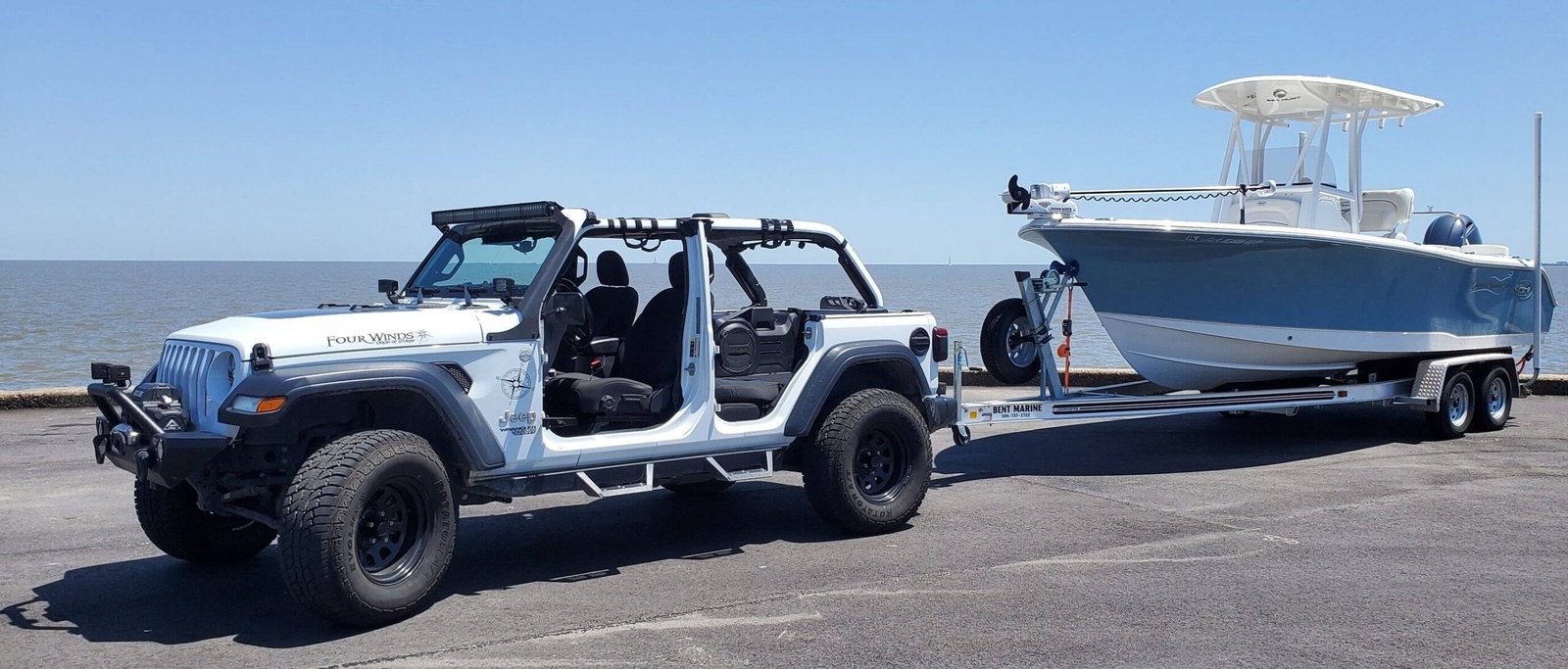
So, can a Jeep Wrangler tow a boat well enough for a real day on the water? For most boat sizes people actually buy, the answer is yes.
This guide walks through exactly what a Jeep Wrangler can tow, which boats fit within that range, and what you need to set it up the right way.
Can a Jeep Wrangler Tow a Boat? Towing Capacity By The Numbers
Towing capacity on a Wrangler isn't one fixed number. It swings based on door count, engine, transmission, and axle setup.
Here's the general breakdown for recent model years (2024 to 2026):
| Configuration | Max Towing Capacity |
|---|---|
| 2-door, any engine | 2,000 lbs |
| 4-door, standard setup | 3,500 lbs |
| 4-door Rubicon/Rubicon X, V6 or turbo-4, 8-speed automatic | 5,000 lbs |
| Rubicon 392 (6.4L V8) | 3,500 lbs |
| Wrangler 4xe (plug-in hybrid) | 3,500 lbs |
A few things worth noting here. The 5,000-pound rating only showed up starting with the 2024 model-year refresh, and only on four-door Rubicon and Rubicon X trims paired with an automatic transmission.
Before that, 3,500 pounds was the ceiling across the lineup.
It's also a little counterintuitive that the V8-powered Rubicon 392 doesn't tow the most. Its curb weight is so much higher than the four-cylinder and V6 versions that it eats into the payload margin, capping it at 3,500 pounds despite having the most horsepower under the hood.
Same story with the 4xe hybrid, the battery pack adds weight, so its max stays at 3,500 pounds too.
So if you’re asking, “Can a Jeep Wrangler tow a boat big enough for my needs?” the takeaway is simple: a four-door Rubicon or Rubicon X with the automatic transmission gives you the most room to work with. For a closer look at how these numbers compare trim by trim, see our Jeep Wrangler trim level guide.
What Size Boat Can a Jeep Wrangler Tow?
Now that you know a Jeep Wrangler can tow a boat, the next question is how big a one? Numbers on a spec sheet are one thing.
What they mean by the water is another. Here's how that translates to real boats, factoring in the trailer weight too (boats are almost always listed by "dry weight," but you need to add the trailer, fuel, and gear on top of that).
Boats a 2-Door Wrangler (2,000 lbs) Can Handle
- Small jon boats or aluminum fishing boats under 14 feet
- Kayaks, canoes, and small inflatable boats on a light trailer
- Compact personal watercraft trailers with one or two jet skis
Boats a Standard 4-Door Wrangler (3,500 lbs) Can Handle
- Aluminum fishing boats up to about 16 to 18 feet
- Small bass boats
- Basic bowriders in the 16-foot range, if lightly equipped
Boats a Rubicon or Rubicon X (5,000 lbs) Can Handle
- Bowriders and runabouts up to roughly 19 to 21 feet
- Pontoon boats on the smaller end, depending on deck size and engine
- Ski and wakeboard boats in the lighter weight classes
A helpful rule of thumb: never plan to tow right up to the max rating. Give yourself a buffer of at least 10 to 15%.
Gear, fuel, coolers, and passengers in the Jeep all count against your margin, so a boat rated at exactly 5,000 pounds is not a boat you want to pull with a Rubicon rated for 5,000 pounds.
What You Need to Tow a Boat With a Wrangler
Towing capacity is only part of the equation. Here’s what actually needs to be in place before you hitch up.
1. The Right Hitch and Receiver
Most Wranglers need a factory or aftermarket Class II or Class III hitch receiver installed. Jeep offers a factory Trailer Tow package on most trims that includes the hitch, wiring harness, and sometimes a heavier-duty cooling package.
If your Wrangler doesn't already have one, this is the first upgrade to make, check Jeep's official towing specs page for the exact package available on your model year, and see our guide to Jeep Wrangler tow hitches for installation notes.
2. Wiring for Trailer Lights and Brakes
Boat trailers need functioning brake lights, turn signals, and often electric brakes on trailers over roughly 3,000 pounds (this threshold varies by state law, the NHTSA trailer safety checklist is a good place to confirm requirements before you tow). A 4-pin or 7-pin wiring harness handles this, check which one your trailer uses before you buy a boat. If your Wrangler throws a trailer-wiring or electrical fault code after hookup, our Jeep DTC code lookup tool can help you diagnose it fast.
3. A Weight-Rated Ball Mount and Ball
The ball size and the mount’s weight rating both need to match or exceed your trailer’s tongue weight and gross weight. This is a cheap part, but using the wrong one is a common, and dangerous, mistake.
4. Properly Inflated Tires and a Cooling Check
Towing puts extra strain on tires and the cooling system. Before a long tow, check tire pressure (including the trailer tires), and make sure your Wrangler’s coolant is topped off, especially in hot weather or on long highway stretches.
5. Mirrors With a Wide Enough View
If the boat and trailer are wider than your Wrangler, factory mirrors may not give you enough visibility. Clip-on towing mirrors are inexpensive and make a real difference for lane changes and backing up to the ramp.
Pros and Cons of Towing a Boat With a Jeep Wrangler
Pros
- Real off-road capability, Wranglers handle steep, gravel, or sandy boat ramps better than most SUVs or sedans, which matters more than people expect at less-maintained launch sites.
- Good ground clearance, Backing a trailer down a rough or uneven ramp is easier without scraping the front or rear bumper.
- 4WD traction, Wet, mossy, or sandy ramps are where 4WD earns its keep, especially when pulling a loaded trailer back up out of the water.
- Iconic, versatile vehicle, It’s a daily driver, an off-roader, and a tow vehicle in one package, which appeals to people who don’t want a dedicated truck just for boat duty.
Cons
- Shorter wheelbase, Especially on two-door models, a short wheelbase means less stability when towing at highway speeds compared to a full-size truck or SUV.
- Lower capacity than trucks, A half-ton pickup can often tow 7,000 to 9,000+ pounds. If you own a larger boat, a Wrangler simply isn’t in that league.
- Ride can feel busy while towing, The solid axle setup that makes Wranglers great off-road can feel less planted towing on the highway compared to an independent suspension setup.
- Fuel economy drops noticeably, Towing any trailer with a Wrangler will cut into an already modest fuel economy number.
Wrangler vs. Other Vehicles for Boat Towing
If you’re cross-shopping, here’s roughly how a Wrangler stacks up against common alternatives:
| Vehicle Type | Typical Max Towing | Best For |
|---|---|---|
| Jeep Wrangler (Rubicon, 4-door) | 5,000 lbs | Small-to-mid boats, rough ramps, off-road access |
| Midsize SUV (e.g., 4Runner) | 5,000 to 5,500 lbs | Similar boat sizes, smoother highway ride |
| Half-ton pickup truck | 7,000 to 13,000 lbs | Larger boats, longer trailers |
| Compact SUV/crossover | 1,500 to 3,500 lbs | Kayaks, jon boats, small PWC trailers |
The Wrangler holds its own against midsize SUVs and even edges out some of them, but it’s not competing with trucks once you get into 22-foot-plus boats or heavier pontoons.
Tips for Towing a Boat With a Wrangler for the First Time
- Practice backing up in an empty lot before your first ramp trip. Trailer steering is reversed from normal driving, and it’s much less stressful to learn this away from a crowded boat launch.
- Load the boat so more weight sits toward the front of the trailer. Around 10 to 15% of the total trailer weight should sit on the hitch (tongue weight). Too little causes sway; too much overloads the rear axle.
- Go slower than you think you need to. Towing at 55 to 60 mph instead of 70+ makes a real difference in stability and stopping distance, especially with a shorter-wheelbase Wrangler.
- Check your state’s brake requirements. Many states require trailer brakes once the loaded trailer crosses a certain weight, commonly somewhere between 1,500 and 3,000 pounds, this varies, so check locally.
- Don’t forget the payload limit. Payload (what your Jeep can carry, including passengers, gear, and hitch weight) is a separate number from towing capacity. A loaded Jeep with four passengers and a cooler has less towing margin left than an empty one.
Frequently Asked Questions About Towing a Boat With a Jeep Wrangler
Can a 2-door Jeep Wrangler tow a boat? Yes, but capacity tops out at 2,000 pounds. That covers small jon boats, kayaks, canoes, and light PWC trailers, not full-size fishing or ski boats.
What’s the biggest boat a Jeep Wrangler can tow? With a four-door Rubicon or Rubicon X and the proper tow package, up to 5,000 pounds, enough for many 19- to 21-foot bowriders or small pontoon boats, once trailer weight is factored in.
Does the Jeep Wrangler 4xe tow less than the gas models? Yes. The 4xe hybrid’s added battery weight caps its towing capacity at 3,500 pounds, even though it has strong torque output.
Do I need a special tow package for my Wrangler? If your Wrangler didn’t come with the factory Trailer Tow package, you’ll likely need to add a hitch receiver and wiring harness before towing anything beyond very light loads.
Is a Jeep Wrangler good for boat ramps? Generally, yes. Ground clearance and 4WD traction make Wranglers well-suited to steep, gravel, or slippery ramps where lower vehicles can struggle.
How do I know my boat and trailer combo is within my Wrangler’s limit? Add the boat’s dry weight, trailer weight, fuel, and gear together, this is your Gross Trailer Weight. Compare that total to your Wrangler’s rated towing capacity, and leave a safety buffer rather than towing at the exact max.
Final Thoughts
So, can a Jeep Wrangler tow a boat? Absolutely, the real question is which Wrangler, and which boat.
A two-door model is fine for a kayak or small jon boat, while a four-door Rubicon with the right setup can handle a genuinely capable day boat. Match your trim and equipment to the boat you actually want, set up the hitch and wiring correctly, and you've got a tow rig that can also crawl the trail on the way home.
For more on keeping your Wrangler running right under the extra load, browse our full Jeep diagnostic code library.