When you add 35 inch tires to your Jeep, the driving experience changes. Larger tires look great and help off-road, but they also affect power, acceleration, and fuel economy.
Choosing the right gear ratio is essential to keep your Jeep running smoothly with these big tires. Many Jeep owners are unsure what gear ratio is best for 35s.
This article will break down all 35 gear ratio options for 35 inch tires, explain their strengths and weaknesses, and help you pick the best one for your needs.

Why Gear Ratio Matters With 35 Inch Tires
A gear ratio controls how many times your driveshaft turns for each rotation of your wheels. With bigger tires, your engine works harder to turn them. The wrong gear ratio can make your Jeep feel slow or burn more fuel. The right gear ratio brings back lost power, keeps the transmission happy, and makes your Jeep more fun to drive—on or off-road.
How To Choose The Best Gear Ratio
The best ratio depends on your Jeep model, transmission type (manual or automatic), how you drive, and where you drive. Most stock Jeeps have ratios between 3.21 and 3.73. When you move to 35 inch tires, you usually need a higher number (lower gears) to compensate.
Gear Ratios For 35 Inch Tires: All 35 Options
Let’s look at the 35 most common gear ratios found or installed in Jeeps with 35 inch tires. For each, you’ll see where it works best, and what to expect.
1. 2.73
Very tall gear. Poor for 35s. Sluggish starts, bad for hills and towing.
2. 3.07
Still too tall for 35 inch tires. Engine struggles, especially with an automatic.
3. 3.21
Common stock ratio. Not enough for 35s. Feels underpowered.
4. 3.31
Slightly better, but still not recommended. OK for flat highways only.
5. 3.42
Marginal improvement, but hills and off-road performance will suffer.
6. 3.55
Somewhat acceptable for light street use, but off-road and towing suffer.
7. 3.73
Minimum recommended for 35s on a manual Jeep. Still sluggish on automatics.
8. 3.90
Noticeable improvement. Good for combined city/highway driving.
9. 4.10
Popular choice. Restores lost power, good balance for daily drivers.
10. 4.27
Great for hilly areas or frequent highway merging.
11. 4.30
Very close to 4. 27, slightly better for automatic Jeeps.
12. 4.56
Excellent for 35s. Strong acceleration, great for off-road.
13. 4.63
Gives even more torque. Good for heavy Jeeps with lots of gear.
14. 4.70
A bit aggressive, but helpful if you run heavy bumpers and armor.
15. 4.88
Very popular. Feels lively. Good for both city and trails.
16. 5.13
High torque. Best for rock crawling or if you haul heavy loads.
17. 5.29
Maxes out engine RPMs quickly. Useful for serious off-road only.
18. 3.08
Very tall. Not recommended unless you drive only on flat highways.
19. 3.50
Rare, not ideal. Still underpowered with 35s.
20. 3.73 Limited Slip
Helps with traction, but ratio itself is still borderline.
21. 4.11
Similar to 4. 10, good compromise for mixed use.
22. 4.56 Limited Slip
Great for off-roaders who need extra grip.
23. 4.88 Limited Slip
Excellent for technical trails and quick starts.
24. 5.38
Extremely low. Only for extreme off-roaders.
25. 4.00
A rare middle ground, but better choices exist.
26. 4.44
Slightly stronger than 4. 10, good for mountain driving.
27. 4.62
Very close to 4. 56, for those wanting a little more torque.
28. 4.72
Niche use, mainly for custom setups.
29. 4.86
Almost identical to 4. 88, great for off-road.
30. 5.00
Very low gearing, best for extreme off-road builds.
31. 5.14
Even lower, mainly for rock crawling.
32. 4.33
Decent for heavy builds that still see street use.
33. 4.71
Another custom ratio, between 4. 56 and 4. 88.
34. 4.88 Electronic Locker
Great for off-road, combines low gearing with locking diff.
35. 5.13 Electronic Locker
Ultimate traction and torque for the most demanding trails.
Quick Gear Ratio Comparison For 35 Inch Tires
Here’s a quick look at how some common ratios compare for Jeep owners with 35 inch tires:
| Gear Ratio | Acceleration | Fuel Economy | Highway RPM (65mph) |
|---|---|---|---|
| 3.73 | Slow | Low | ~2000 |
| 4.10 | Moderate | Medium | ~2200 |
| 4.56 | Strong | Lower | ~2400 |
| 4.88 | Very Strong | Lowest | ~2600 |
Automatic Vs Manual: Does It Matter?
Automatic Jeeps usually need a slightly higher gear ratio than manuals. If you have an automatic, go for 4.56 or higher. Manuals can work with 4.10 or 4.56.
City, Highway, And Off-road: Which Ratio?
Your main driving style matters:
- Mostly City: 4.10 or 4.56
- Highway Only: 4.10 (accept some sluggishness)
- Off-Road: 4.56 or 4.88
- Heavy Towing: 4.88 or higher
Real-world Example
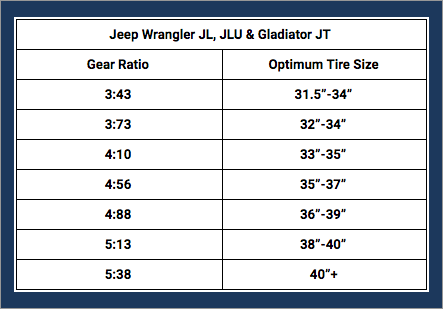
A Jeep Wrangler JL with automatic transmission, 3.6L engine, and 35 inch tires feels best with a 4.56 or 4.88 ratio. Owners report improved throttle response, less transmission hunting, and better crawl control.
Common Mistakes When Re-gearing
- Picking too tall a gear (like 3.73) and feeling underpowered.
- Forgetting to re-calibrate the speedometer for larger tires.
- Not considering axle strength when going below 4.88.
- Ignoring transmission type.
- Over-gearing (5.13+) for street Jeeps, hurting fuel economy.
How To Know If You Need To Re-gear
If your Jeep feels slow, shifts a lot on hills, or the RPMs are too low/high at highway speed, it’s time to re-gear. The right ratio makes driving easier and safer.
Popular Aftermarket Brands
Many owners choose trusted brands like Yukon Gear, Motive Gear, and G2 Axle & Gear for re-gearing. Professional installation is recommended for best results.
Cost To Re-gear
Expect to pay between $1,300–$2,000 for parts and labor. Both front and rear axles must match ratios.
Quick Gear Ratio Reference Table
For 35 inch tires, here are the most recommended gear ratios:
| Engine | Transmission | Recommended Ratio |
|---|---|---|
| 3.6L V6 | Automatic | 4.56 |
| 3.6L V6 | Manual | 4.10 |
| 2.0L Turbo | Auto/Manual | 4.56 |
| Diesel | Any | 4.10 |
For more technical details, see Jeep Official.
Frequently Asked Questions
What Is The Best Gear Ratio For 35 Inch Tires On A Jeep Wrangler?
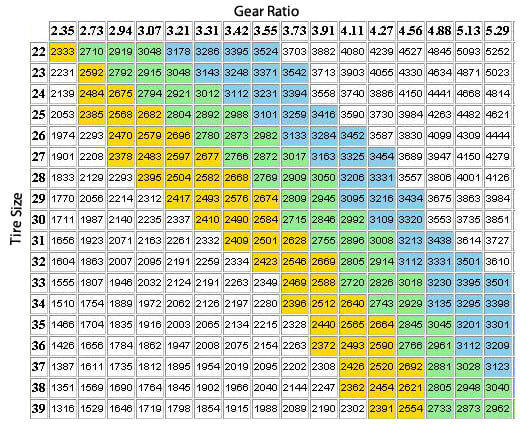
4.56 is ideal for most, but 4.88 is great for heavy builds or off-road focus.
Can I Run 35 Inch Tires With Stock Gears?
You can, but performance will drop. Upgrading is highly recommended.
Will Re-gearing Improve My Gas Mileage?
It can restore lost mileage, but large tires still reduce fuel economy compared to stock.
Do I Need To Change Both Front And Rear Gears?
Yes, both must match to avoid damage.
Is Re-gearing A Diy Job?
It’s a complex job requiring special tools. Most owners hire a professional.