The Jeep Wrangler Sport S lease offers a compelling way for many drivers to get behind the wheel of an iconic off-road vehicle without the long-term commitment of buying.
Leasing can be an attractive option, especially for those who like to drive a new vehicle every few years or who want lower monthly payments compared to financing.
The Sport S trim is a popular choice, striking a balance between essential features and affordability, making it a prime candidate for leasing.

Understanding what a Jeep Wrangler Sport S lease entails is crucial before signing any paperwork. This involves looking at the lease terms, the typical costs involved, and the advantages and disadvantages compared to buying. It’s not just about the monthly payment; it’s about the total cost, the mileage limits, and what happens at the end of the lease term. For many, the allure of the Wrangler’s legendary capability, combined with the financial flexibility of a lease, makes this a very desirable package.
This guide will walk you through everything you need to know about leasing a Jeep Wrangler Sport S. We’ll break down the components of a lease, discuss what makes the Sport S trim appealing, and help you understand if this type of deal is the right fit for your lifestyle and budget.
We will also explore common questions and considerations to ensure you make an informed decision.
Understanding Jeep Wrangler Sport S Lease Basics
A Jeep Wrangler Sport S lease is essentially a long-term rental agreement. You pay to use the vehicle for a set period, typically 24, 36, or 48 months, and a fixed number of miles per year. At the end of the lease, you have options: return the vehicle, buy it for a predetermined price, or lease a new one. Unlike buying, you don’t own the vehicle; you are paying for the depreciation during the lease term, plus interest and fees.
The Jeep Wrangler Sport S trim is often considered the sweet spot for many buyers and lessees. It builds upon the base Sport model by adding desirable features without escalating the price too dramatically. Key additions usually include alloy wheels, power windows and locks, a leather-wrapped steering wheel, and often an upgraded infotainment system with a larger touchscreen and Apple CarPlay/Android Auto compatibility. These enhancements make the daily driving experience more comfortable and convenient, while still retaining the core Wrangler DNA that makes it so popular.
When you are looking at a lease deal, several factors determine your monthly payment. These include the MSRP (Manufacturer’s Suggested Retail Price) of the specific Wrangler Sport S you choose, the money factor (which is similar to an interest rate), the residual value (the estimated value of the Jeep at the end of the lease), the lease term (how long the lease lasts), and your annual mileage allowance. Dealerships and manufacturers also offer incentives and rebates that can significantly reduce the cost of a lease.
The money factor is often expressed as a small decimal number, like 0.00125. To convert this to an approximate annual percentage rate (APR), you multiply it by 2400. So, 0.00125 x 2400 = 3% APR. This is a crucial part of the lease cost, as it’s the finance charge applied to the amount the vehicle depreciates. The residual value is set by the leasing company and is usually a percentage of the MSRP. Jeeps, especially Wranglers, tend to hold their value well, which can lead to lower monthly payments on leases because the depreciation is less.
Key Components Of A Wrangler Sport S Lease Agreement
When you review a lease contract for a Jeep Wrangler Sport S, you’ll see several key terms that define the agreement. Understanding these will help you avoid surprises and ensure you’re getting a fair deal.
- Capitalized Cost (Cap Cost): This is the agreed-upon price of the vehicle for the lease. It’s similar to the purchase price but can often be negotiated down. The lower the cap cost, the lower your monthly payments will be.
- Capitalized Cost Reduction: This refers to any down payment, trade-in value, or rebates applied to reduce the cap cost. A larger cap cost reduction means lower monthly payments.
- Money Factor: As mentioned earlier, this is the interest rate charged on the lease. It’s vital to understand this rate, as a lower money factor means less interest paid over the lease term.
- Residual Value: This is the projected value of the Wrangler Sport S at the end of the lease. A higher residual value means the Jeep is expected to be worth more, resulting in lower depreciation and thus lower monthly payments.
- Lease Term: This is the duration of the lease agreement, commonly 24, 36, or 48 months. Longer terms usually mean lower monthly payments but you’ll pay more interest overall and be in the vehicle longer.
- Annual Mileage Allowance: This is the maximum number of miles you can drive per year without incurring excess mileage charges. Common allowances are 10,000, 12,000, or 15,000 miles per year. Exceeding this limit will result in a per-mile charge at the end of the lease.
- Acquisition Fee: This is a fee charged by the leasing company to set up the lease. It can sometimes be rolled into the monthly payments.
- Disposition Fee: This is a fee charged at the end of the lease when you return the vehicle. It covers the costs of inspecting and preparing the vehicle for resale. Some manufacturers waive this fee if you lease or buy another vehicle from them.
- Early Termination Fees: If you need to end the lease before the term is up, there are usually substantial penalties. These can include paying the remaining lease payments, depreciation, and other fees.
Why Lease A Jeep Wrangler Sport S?
Leasing a Jeep Wrangler Sport S appeals to a specific type of driver. The primary draw is often the lower monthly payments. Because you’re only paying for the vehicle’s depreciation during the lease term, rather than its full value, your monthly payments are typically less than if you were financing to buy. This can allow you to drive a higher trim level or a more expensive vehicle than you might be able to afford if purchasing outright.
Another significant advantage is the ability to drive a new vehicle every few years. For those who enjoy having the latest technology, safety features, and design, leasing provides a regular refresh cycle. When your lease is up, you can simply turn in the keys and drive off in a brand-new model. This also means you are generally driving a vehicle that is still under warranty, reducing the likelihood of unexpected repair costs. The Wrangler Sport S, with its desirable features, becomes more accessible with a lease.
Furthermore, leasing can be simpler at the end of the term. If you choose to return the vehicle, you typically just need to pay any outstanding fees and charges (like excess mileage or wear and tear) and hand back the keys.
You avoid the hassle of selling or trading in a used car, which can be time-consuming and stressful. This ease of transition is a major benefit for many lessees.
The Jeep Wrangler Sport S: Features And Appeal
The Jeep Wrangler Sport S trim is a popular choice for a reason. It offers a significant upgrade over the base Sport model, providing a much more comfortable and feature-rich experience without venturing into the higher price brackets of the Rubicon or Sahara trims. This makes it an excellent candidate for a lease, as it balances desirability with a more manageable cost.
At its core, the Sport S trim is still a Wrangler. This means you get the iconic styling, the legendary off-road capability (even in its most basic form), and the open-air driving experience that Jeep is famous for. Whether it’s the removable doors, the fold-down windshield, or the removable roof panels, the Wrangler offers a connection to the outdoors that few other vehicles can match. The Sport S trim doesn’t compromise on these fundamental Wrangler traits.
Standard And Optional Features On The Sport S
The Jeep Wrangler Sport S lease often comes with a set of features that enhance both the daily drive and the overall ownership experience. While exact configurations can vary by model year and region, here are some common inclusions that make the Sport S stand out:
- Wheels: Typically includes 17-inch alloy wheels, a step up from the steel wheels found on the base Sport. These not only look better but are also lighter.
- Power Features: Power windows, power door locks, and power-adjustable heated mirrors are usually standard. This adds a significant level of convenience for everyday use.
- Steering Wheel: A leather-wrapped steering wheel with integrated audio and cruise controls is a common upgrade, improving grip and comfort.
- Infotainment System: Many Sport S models come with a Uconnect infotainment system, often featuring a 7-inch touchscreen display. This usually includes Apple CarPlay and Android Auto integration, allowing for seamless smartphone connectivity for navigation, music, and calls.
- All-Season Floor Mats: These are often included, providing extra protection for the interior, especially important for a vehicle designed for off-road adventures.
- Tinted Windows: Rear privacy glass is often standard, offering shade and security.
Optional packages can further enhance the Sport S. These might include a more advanced navigation system, a premium audio system, heated seats, or different roof configurations.
When leasing, it’s important to note which features are included in the specific vehicle you are considering, as they will affect its residual value and thus your lease payment.
Off-road Prowess Of The Sport S
While trims like the Rubicon are built for extreme off-roading, the Jeep Wrangler Sport S is still remarkably capable. It comes standard with Jeep’s Command-Trac part-time 4×4 system, which is a robust and reliable system for various conditions. This system allows you to shift between 2WD and 4WD modes on the fly, making it suitable for both on-road driving and off-road trails.
The Sport S also benefits from the Wrangler’s inherent design advantages for off-roading:
- High Ground Clearance: The Wrangler sits high off the ground, allowing it to clear obstacles on trails.
- Short Wheelbase: This contributes to a good breakover and departure angle, essential for tackling steep inclines and declines.
- Solid Axles: While some modern vehicles have independent suspension, Wranglers use solid front and rear axles. This design is simpler, more durable, and offers better articulation (flexibility) for maintaining tire contact on uneven terrain.
While it may not have the locking differentials or the electronically disconnecting sway bar found on the Rubicon, the Sport S is more than capable for most trail users, weekend adventurers, and those who simply want the confidence of 4×4 capability in snow or inclement weather.
This capability is a key part of the Wrangler’s appeal, and it’s fully present in the Sport S trim.
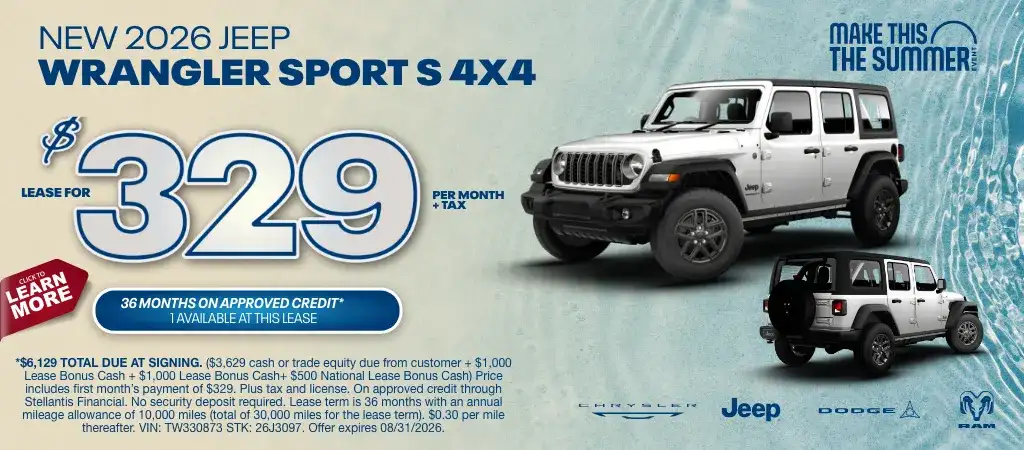
Calculating Your Jeep Wrangler Sport S Lease Costs
Understanding the financial aspect of a Jeep Wrangler Sport S lease is crucial. While monthly payments might seem straightforward, several factors contribute to the total cost over the lease term. Being aware of these can help you negotiate a better deal and avoid unexpected expenses.
The monthly payment is calculated based on the difference between the vehicle’s selling price (cap cost) and its residual value, divided by the number of months in the lease term. To this amount, you add the finance charge (based on the money factor) and any applicable taxes and fees.
Estimating Your Monthly Payment
Let’s consider an example to illustrate how a monthly payment might be estimated. Suppose a Jeep Wrangler Sport S has an MSRP of $40,000.
- Negotiated Cap Cost: Let’s say you negotiate the selling price down to $37,000.
- Residual Value: A 36-month lease with 12,000 miles per year might have a residual value of 60% of MSRP. So, $40,000 * 0.60 = $24,000.
- Depreciation: The amount the vehicle is expected to depreciate is $37,000 (Cap Cost) – $24,000 (Residual Value) = $13,000.
- Monthly Depreciation Cost: $13,000 / 36 months = approximately $361 per month.
Now, let’s factor in the finance charge.
- Money Factor: Assume a money factor of 0.00150 (equivalent to a 3.6% APR).
- Average Lease Balance: A simplified way to estimate the balance on which interest is charged is (Cap Cost + Residual Value) / 2. So, ($37,000 + $24,000) / 2 = $30,500.
- Monthly Finance Charge: $30,500 * 0.00150 = approximately $45.75 per month.
Adding these together: $361 (Depreciation) + $46 (Finance Charge) = $407 per month.
This is a simplified calculation. Your actual payment will also include taxes on the monthly payment, acquisition fees, and potentially other dealer fees.
It's also important to remember that if you put money down (cap cost reduction), it reduces the cap cost and thus your monthly payment.
The Impact Of Down Payment And Trade-ins
When you lease a Jeep Wrangler Sport S, you might be tempted to make a substantial down payment or trade in your current vehicle. While this can lower your monthly payments, it’s important to understand the implications.
Down Payment: Any money you pay upfront reduces the capitalized cost, leading to lower monthly payments. However, if the vehicle is totaled in an accident, you will not be reimbursed for your down payment, as insurance typically pays out the actual cash value (ACV) of the vehicle or the lease payoff amount, whichever is less. This is a significant risk.
Trade-In: Similar to a down payment, a trade-in reduces the cap cost. If your trade-in value exceeds the amount you owe on the vehicle, the difference can be applied to the lease. However, if you owe more on your trade-in than it’s worth, you’ll need to pay the difference, and this negative equity can also be rolled into the lease, increasing your monthly payments and the total amount you pay over the lease term.
In my experience, it's often advisable to minimize or avoid a large down payment on a lease. This is because you are essentially prepaying for a portion of the vehicle's value that you will never own.
If the car is stolen or declared a total loss, that money is gone.
A lower down payment, even if it means