Death wobble is one of the most unsettling problems a Jeep owner can experience. One moment the Jeep feels normal; the next, the steering wheel and front axle shake violently after hitting a bump, pothole, bridge joint, or rough patch of road.
It often happens at road speed, and it usually stops only after you slow down.
The good news: death wobble can be fixed. The frustrating part is that it is rarely solved by guessing or replacing one random part.
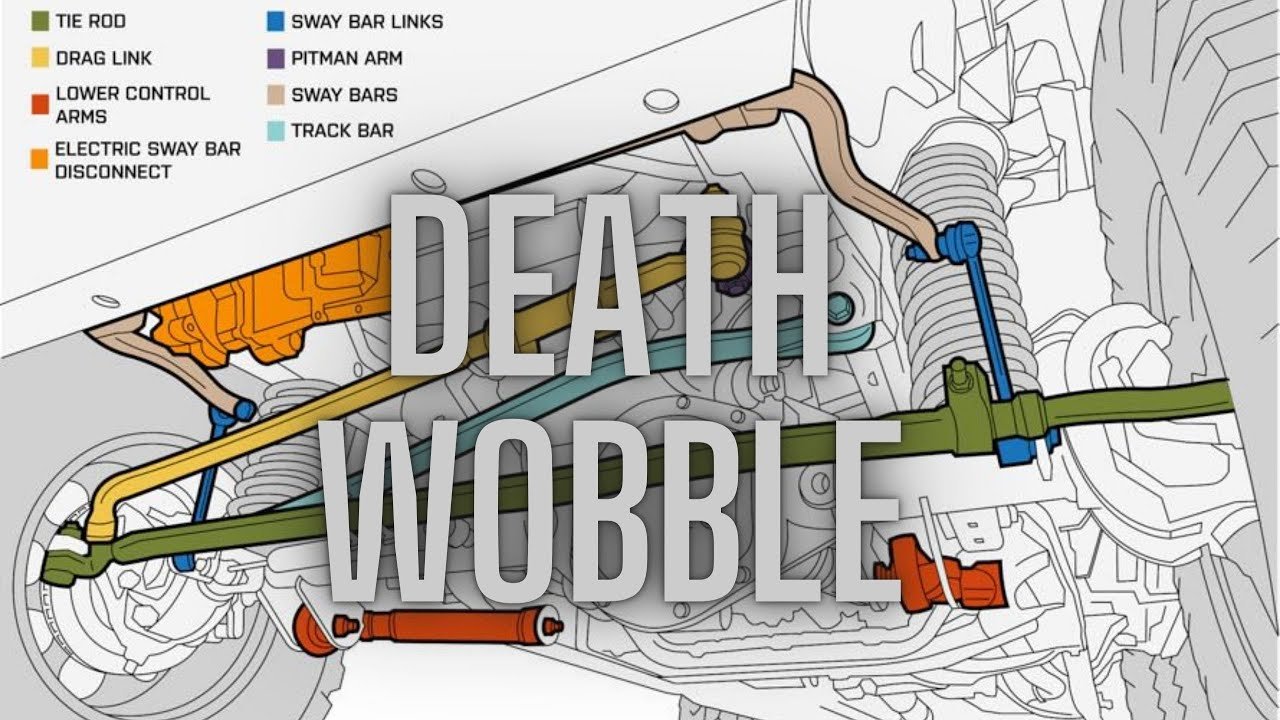
A steering stabilizer may calm the shake for a while, but it does not cure the root problem. The real fix is finding the looseness, bad geometry, tire issue, or worn component that lets the front axle oscillate.
This guide gives you a practical order of diagnosis so you can stop wasting money and track down the cause.
Quick Answer
To stop Jeep death wobble, inspect the front end in this order:
- Check tire pressure, tire condition, and wheel balance.
- Perform a dry-steer test to find movement in the track bar, tie rod, drag link, ball joints, and control arms.
- Inspect the track bar, bolts, bushings, and mounting holes.
- Check ball joints, wheel bearings, tie rod ends, drag link ends, and control arm bushings.
- Torque all suspension and steering bolts to factory spec.
- Get a proper alignment and confirm caster, toe, and steering wheel center.
- Replace worn parts with quality components.
- Use a steering stabilizer only after the root cause is fixed.
If the wobble happens at highway speed, do not keep driving as if it is normal. Slow down safely, avoid sudden steering input, and inspect the Jeep before the next long drive.
What Is Death Wobble?
Death wobble is a rapid side-to-side shaking of the front suspension and steering system. It is most common on solid front axle vehicles, including many Jeep Wrangler and Cherokee models.
The shake often starts after a bump because the impact gives the suspension a sudden input. If something in the front end is loose, worn, misaligned, or poorly controlled, the axle and steering can begin to oscillate.
Once the shaking starts, the steering wheel can move violently, and the front tires may feel like they are bouncing or fighting each other.
Death wobble is not the same as a normal vibration. A tire balance problem may cause a steady vibration at a certain speed.
Death wobble is more violent and usually feels like the whole front axle is shaking.
What To Do When It Happens
If death wobble starts while driving:
- Hold the steering wheel firmly, but do not yank it.
- Let off the throttle.
- Brake smoothly and slow down.
- Move to a safe place when possible.
- Do not keep driving at speed until the Jeep is inspected.
Avoid panic braking or sudden lane changes if you can. The goal is to reduce speed and settle the front end without adding more steering input.
Common Causes of Jeep Death Wobble
Death wobble usually comes from a combination of problems. One loose part may start it, but worn tires, poor alignment, and weak steering parts can make it worse.
| Cause | Why It Matters | What To Check |
|---|---|---|
| Loose or worn track bar | The track bar controls side-to-side axle movement. Even small movement can trigger wobble. | Bushings, bolts, brackets, mounting holes, welds |
| Bad tire balance | Out-of-balance tires can start the shake at speed. | Road-force balance, missing wheel weights, bent wheels |
| Out-of-round or damaged tires | A tire that does not roll smoothly can feed vibration into the axle. | Flat spots, bulges, uneven tread, radial runout |
| Low caster | Too little caster makes the Jeep feel twitchy and less stable. | Alignment printout, control arm length, lift geometry |
| Incorrect toe | Toe that is too far in or out can make the front tires fight each other. | Total toe setting, steering wheel center |
| Worn ball joints | Allows the knuckle and tire to move when they should stay controlled. | Vertical and horizontal play |
| Worn tie rod or drag link ends | Creates play between the steering box and wheels. | Joint movement during dry-steer test |
| Bad wheel bearings/unit bearings | Lets the wheel move on the hub. | Tire movement at 12 and 6 o’clock, noise, roughness |
| Loose control arms | Allows axle movement under load. | Bushings, bolts, brackets, torque |
| Weak steering stabilizer | Does not cause death wobble by itself, but can make symptoms easier to trigger. | Leaks, dead spots, loose mounts |
Jeep Models Most Affected
Solid front axle Jeeps are the most commonly affected because the front wheels are tied together by the axle housing.
| Jeep Model | Front Suspension Type | Death Wobble Risk |
|---|---|---|
| Wrangler TJ (1997-2006) | Solid front axle | High |
| Wrangler JK (2007-2018) | Solid front axle | High |
| Wrangler JL (2018+) | Solid front axle | High |
| Cherokee XJ (1984-2001) | Solid front axle | Medium to high |
| Grand Cherokee ZJ/WJ | Solid front axle | Medium |
| Newer independent-front-suspension Grand Cherokee models | Independent front suspension | Much lower |
Lift kits, larger tires, heavy wheels, off-road use, and worn high-mileage parts all increase the odds.
Step 1: Check Tires First
Tires are easy to overlook because they are not as exciting as suspension parts, but they can start or worsen death wobble.
Check:
- Tire pressure on all four tires
- Uneven wear
- Cupping or feathering
- Bulges or sidewall damage
- Bent wheels
- Missing wheel weights
- Mud packed inside wheels
- Out-of-round tires
If the Jeep shakes at a certain speed even on smooth pavement, get the tires balanced. A road-force balance is better than a basic spin balance because it can find tire and wheel problems that a normal balance may miss.
NHTSA recommends regular tire pressure checks, tire rotation, balance, and alignment as part of tire safety and tire life. That advice matters even more on a Jeep with larger tires because heavy tire-and-wheel packages put more load into the steering system.
Step 2: Do a Dry-Steer Test
The dry-steer test is one of the best ways to find death wobble problems.
Here is how to do it:
- Park the Jeep on level ground.
- Keep the tires on the ground.
- Start the engine if power steering assist is needed.
- Have someone turn the steering wheel left and right in short movements.
- Watch the front suspension and steering parts closely.
Look for movement in:
- Track bar frame-side joint
- Track bar axle-side joint
- Track bar brackets
- Tie rod ends
- Drag link ends
- Steering box area
- Ball joints
- Control arm bushings
- Track bar bolt holes
The key is timing. If a bracket, bolt, bushing, or joint moves before the tires respond, that part is suspect.
Even a tiny amount of movement at the track bar can become violent at road speed.
Step 3: Inspect the Track Bar Carefully
The track bar is one of the most common death wobble trouble spots. It locates the axle side-to-side under the Jeep.
When the track bar or its mounts have play, the axle can shift left and right while the steering tries to correct it.
Inspect:
- Track bar bushings
- Heim or joint ends, if aftermarket
- Frame-side bracket
- Axle-side bracket
- Bolt torque
- Bolt size
- Wallowed or ovaled mounting holes
- Cracked welds
A new track bar will not solve the problem if the mounting hole is damaged. If the bolt hole is ovaled out, the bolt can move even when it feels tight.
In that case, the fix may require a bracket repair, weld washer, correct-size bolt, or replacement bracket.
Step 4: Check Ball Joints, Tie Rod Ends, and Wheel Bearings
Death wobble often survives because one worn part is missed.
For ball joints:
- Lift the tire safely.
- Check for vertical and horizontal play.
- Watch the upper and lower ball joints while moving the tire.
- Replace worn joints in pairs when needed.
For tie rod and drag link ends:
- Use the dry-steer test.
- Watch each joint for looseness.
- Look for torn boots or grease loss.
- Replace joints that move before the linkage moves.
For unit bearings:
- Grab the tire at 12 and 6 o’clock.
- Rock it in and out.
- Listen for grinding or humming on the road.
- Confirm the movement is not coming from the ball joints.
If you are unsure where the play is coming from, have a Jeep shop inspect it. Guessing gets expensive.
Step 5: Torque Every Front-End Bolt
Loose bolts are a simple cause, but they are easy to miss. Use a torque wrench and the correct service manual specs for your Jeep model.
Check:
- Track bar bolts
- Control arm bolts
- Tie rod and drag link hardware
- Steering stabilizer mounts
- Sway bar links
- Shock bolts
- Wheel lug nuts
Do not rely on “feels tight.” Suspension bolts can feel snug but still be under-torqued. If a bolt has been moving inside a bracket, inspect the hole for wear before tightening it again.
Step 6: Get the Alignment Right
Alignment does not always cause death wobble by itself, but poor alignment can make the Jeep easier to upset.
Ask for an alignment printout and check:
- Caster
- Toe
- Steering wheel center
- Thrust angle
- Tire wear pattern
For many solid-axle Wranglers, a small amount of toe-in and enough positive caster help stability. A common starting range for many lifted Jeeps is about 5 to 6 degrees of caster and roughly 1/16 to 1/8 inch total toe-in, but this is not universal. Your Jeep’s model, lift height, tire size, control arms, and front driveshaft angle all matter.
Important alignment notes:
- Low caster can make the Jeep wander and feel unstable.
- Too much caster can create front driveshaft vibration on some lifted Jeeps.
- Camber is not normally adjustable on solid front axle Wranglers without special parts.
- Centering the steering wheel matters because some Jeeps use steering angle data.
If the Jeep is lifted, adjustable control arms or geometry correction brackets may be needed to get the numbers right.
Step 7: Do Not Use the Steering Stabilizer as the Cure
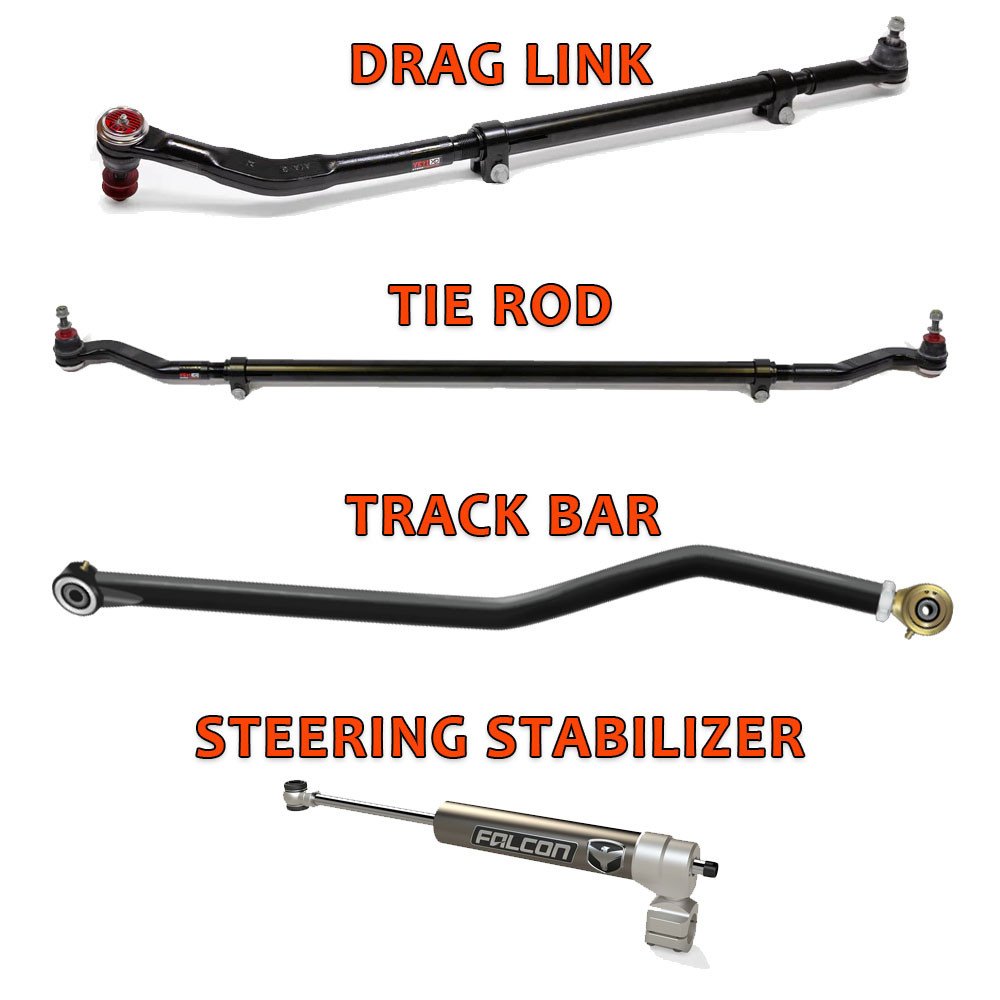
A steering stabilizer can reduce kickback and calm minor shimmy, but it is not the root fix for death wobble. Think of it like a shock absorber for the steering system.
It can damp movement, but it cannot repair a loose track bar, bad tire, worn ball joint, or poor alignment.
Replace a steering stabilizer if:
- It is leaking
- It has dead spots
- The shaft is bent
- The bushings are worn
- The mounts are loose
But if a new stabilizer is the only repair, the wobble may return.
Repair Priority Table
Use this table to decide what to inspect first.
| Priority | Area | Why It Comes Early |
|---|---|---|
| 1 | Tires and wheels | Balance, runout, pressure, and damage can trigger wobble. |
| 2 | Track bar and brackets | Small movement here is one of the most common root causes. |
| 3 | Steering linkage | Tie rod and drag link play lets the tires steer themselves. |
| 4 | Ball joints and unit bearings | Worn joints let the tire and knuckle move under load. |
| 5 | Control arms and bushings | Axle movement changes caster and steering feel. |
| 6 | Alignment | Caster, toe, and steering wheel center affect stability. |
| 7 | Steering stabilizer | Helps damping after the real problem is fixed. |
Cost To Fix Jeep Death Wobble
Costs vary by model, tire size, labor rate, and how many parts are worn.
| Repair | Typical Cost Range |
|---|---|
| Tire balance | $60-$150 |
| Road-force balance | $100-$250 |
| Wheel alignment | $100-$200 |
| Track bar replacement | $200-$600 |
| Track bar bracket repair | $150-$600+ |
| Tie rod or drag link repair | $200-$900 |
| Ball joint replacement | $400-$1,000+ |
| Unit bearing replacement | $250-$700 per side |
| Control arm or bushing repair | $250-$1,200+ |
| Steering stabilizer replacement | $80-$250 |
Do not spend the whole budget on a stabilizer first. Put the money toward diagnosis, tires, track bar inspection, and steering/suspension play.
Best Parts Strategy
Quality parts matter, especially on lifted Jeeps or Jeeps with oversized tires. Budget parts may be fine on a stock daily driver, but a lifted Wrangler with heavy tires puts more stress on joints and bushings.
Consider heavy-duty parts when:
- The Jeep has larger-than-stock tires
- The Jeep is lifted
- The Jeep is used off-road
- The same part has failed more than once
- The track bar or steering linkage has visible flex
Better parts can help, but they will not fix bad geometry, ovaled bracket holes, loose bolts, or tire problems. Confirm the root cause first.
Maintenance To Keep Death Wobble From Coming Back
Every oil change or every 5,000 miles, check:
- Tire pressure
- Tire wear
- Lug nut torque
- Track bar bolts
- Steering linkage play
- Ball joints
- Unit bearings
- Control arm bushings
- Alignment if tire wear changes
After off-road trips, also check:
- Bent steering links
- Impact marks on wheels
- Mud packed inside wheels
- Loose suspension bolts
- Torn boots
- Leaking shocks or stabilizer
If you have larger tires, rotate and balance them regularly. Heavy tires punish small problems.
Common Mistakes
Avoid these:
- Replacing only the steering stabilizer
- Ignoring tiny track bar movement
- Installing a new track bar into damaged mounting holes
- Skipping tire road-force balance
- Forgetting to torque bolts after suspension work
- Aligning the Jeep without checking worn parts first
- Assuming new parts are good just because they are new
- Using cheap parts on a lifted Jeep with heavy tires
- Not asking for an alignment printout
- Ignoring caster after a lift
What is the most common cause of Jeep death wobble?
A loose or worn track bar is one of the most common causes, especially if the bushings, bolts, brackets, or mounting holes have play. Tires, ball joints, steering linkage, and alignment can also be involved.
Can death wobble be fixed permanently?
Yes. It can be fixed if the real cause is found and repaired.
The problem comes back when the repair only hides the shake or misses another loose part.
Is it safe to drive with death wobble?
No. If it happens, slow down safely and inspect the Jeep before continuing high-speed driving.
Repeated death wobble can damage steering and suspension parts.
Will a steering stabilizer stop death wobble?
It may reduce the symptom, but it will not fix the root cause. Replace a bad stabilizer if needed, but inspect the tires, track bar, steering linkage, ball joints, bearings, and alignment first.
Can bad tires cause death wobble?
Yes. Out-of-balance, out-of-round, cupped, damaged, or unevenly worn tires can trigger wobble.
Road-force balancing is often worth doing on lifted Jeeps or Jeeps with larger tires.
What alignment specs help reduce death wobble?
There is no single spec for every Jeep. Many lifted solid-axle Jeeps are more stable with roughly 5 to 6 degrees of caster and a small amount of toe-in, but exact specs depend on model, lift, tire size, and driveline angle. Always ask for a printout.
Do lifted Jeeps get death wobble more often?
They can. Lift kits change steering and suspension geometry.
Larger tires also add weight and leverage. A lifted Jeep needs proper caster, track bar angle, steering geometry, and stronger parts if it is used hard.
Bottom Line
Death wobble is fixable, but it needs diagnosis instead of guesswork. Start with tires, then perform a dry-steer test, inspect the track bar and brackets, check every steering and suspension joint, torque the hardware, and confirm alignment with a printout.
If the Jeep has been lifted or has larger tires, pay extra attention to caster, track bar angle, steering linkage, and part quality. A steering stabilizer can help after the repair, but it should never be treated as the cure.


















I have replaced everything on the front suspension, the track bar twice. It still wobbles. Are their better alignment specs that reduce problem? I used moog parts but would a better brand help?
Hi, if you’ve already replaced most of the front suspension and the track bar twice, I would stop replacing parts for a moment and focus on finding any movement that is still being missed.
First, do a dry-steer test. Have someone turn the steering wheel left and right while the Jeep is parked, and watch the track bar, drag link, tie rod, ball joints, and control arm mounts. If the track bar bolt, bushing, or bracket moves even slightly before the tires move, that can still trigger death wobble.
Also check the track bar mounting holes. If the holes are ovaled out or the bracket is flexing, a new track bar will not fix it.
For alignment, there is no one perfect spec for every Jeep, but many solid-axle Jeeps do better with:
If the Jeep is lifted and caster is too low, you may need adjustable control arms or geometry correction brackets.
Moog parts can work on a stock Jeep, but if you have larger tires or a lift, heavy-duty Jeep-focused parts may hold up better. Still, brand alone will not fix death wobble if the real issue is tire balance, low caster, loose bolts, bad bracket holes, or an out-of-round tire.
My order would be:
A steering stabilizer can help control feedback, but it should not be used as the fix. Death wobble always has a root cause.