Getting stuck on a muddy trail or snowy road is never fun. If you drive a Jeep Wrangler, you have a powerful tool to help: 4WD (four-wheel drive).
But many beginners don’t know how to use it correctly. Some worry about damaging their vehicle.
Others just want to learn how to put their Jeep Wrangler into 4WD without mistakes. show you exactly how to do it, step by step, and explain the pros and cons.
You’ll also see comparisons with other systems, costs, and practical tips. Whether you drive an older Wrangler or a new model, you’ll get clear answers and avoid common problems.
Understanding Jeep Wrangler 4wd Systems
Before you switch your Jeep Wrangler into 4WD, it helps to understand the different 4WD systems. Most Wranglers use either part-time 4WD or full-time 4WD. Knowing which system you have is key.
Part-time 4wd
Most Jeep Wrangler models come with part-time 4WD. This means you drive in 2WD for normal roads, and shift to 4WD for slippery or rough surfaces. Part-time 4WD is best for off-road, snow, sand, and mud.
Full-time 4wd
Some newer Wranglers offer full-time 4WD (like the Selec-Trac system). Here, you can drive in 4WD all the time, even on dry pavement. The system automatically manages how power goes to each wheel.
Main Differences
Here is a quick comparison of the two systems:
| Feature | Part-Time 4WD | Full-Time 4WD |
|---|---|---|
| Best for | Off-road, slippery surfaces | All conditions |
| Can use on dry pavement? | No | Yes |
| Manual shifting? | Yes | No (automatic) |
| Common in | Older models | Newer models (JL, Rubicon) |
Most drivers use part-time 4WD, so focus mainly on that system.
When Should You Use 4wd In A Jeep Wrangler?
Using 4WD at the right time is important. If you use it on dry roads, you risk drivetrain damage and extra tire wear. If you wait too long in mud, you could get stuck.
Here are the best times to switch your Wrangler into 4WD:
- Snow and ice: Helps prevent slipping and gives more control.
- Mud and sand: Makes it easier to get through sticky or loose ground.
- Off-road trails: Rocks, hills, or uneven surfaces need extra traction.
- Heavy rain: If roads are very slippery, 4WD can help.
Avoid using 4WD on dry, paved roads unless you have a full-time system. It’s not designed for that, and it can cause expensive problems.
Step-by-step: How To Put Jeep Wrangler Into 4wd
Putting your Wrangler into 4WD is simple, but you need to do it correctly. Here’s how:
1. Identify Your Transfer Case
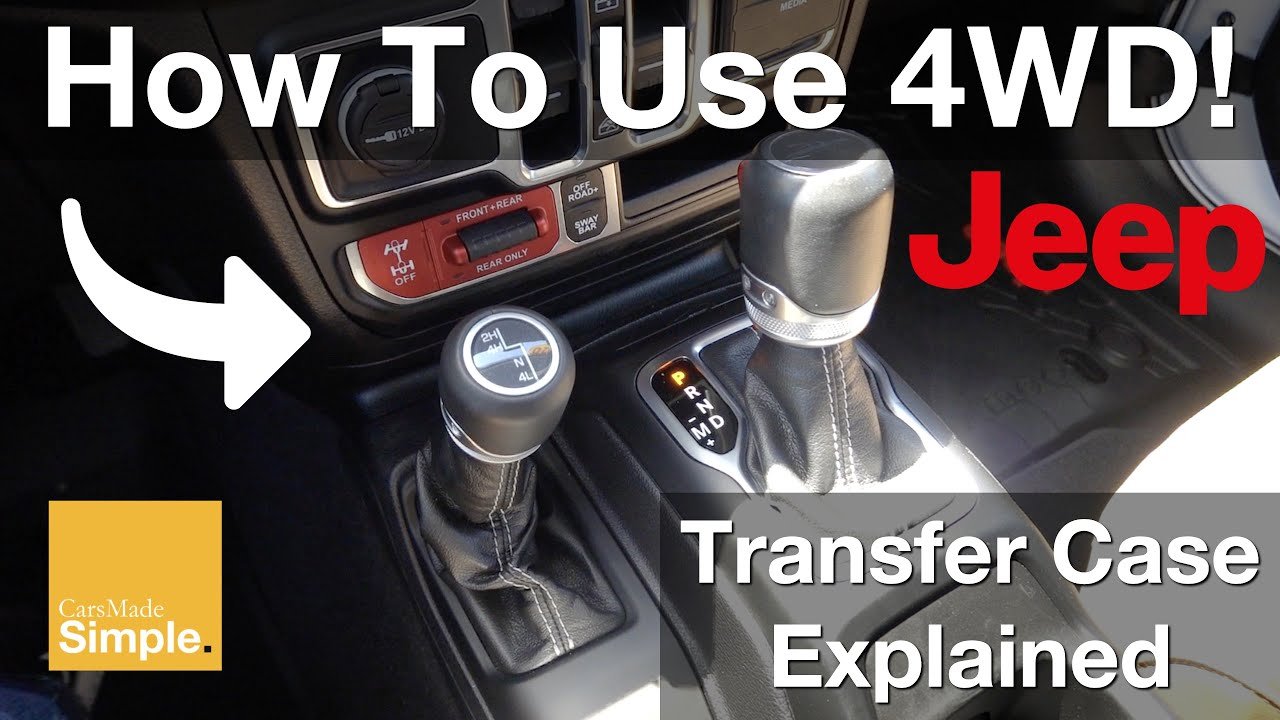
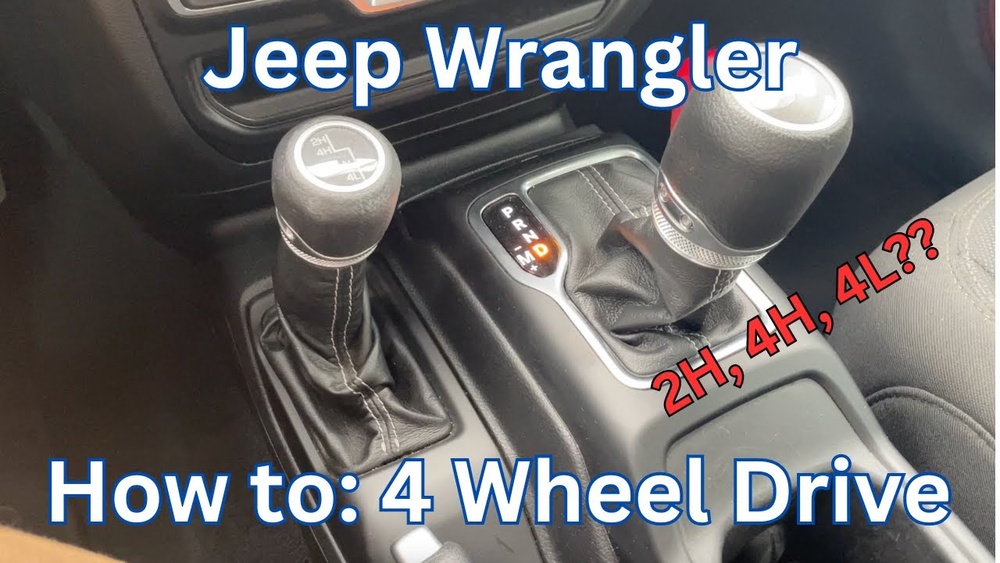
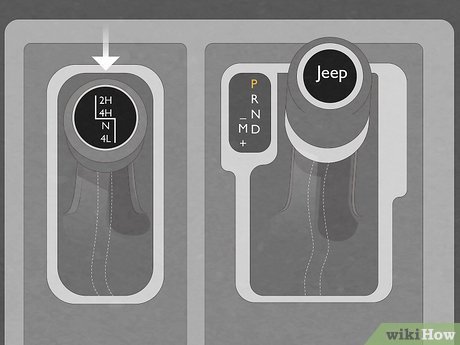
The transfer case is what lets you switch between 2WD and 4WD. Most Jeep Wranglers have a lever or knob near the gear shift. Check your owner’s manual if you’re not sure.
2. Know The Modes
Your transfer case usually has these settings:
- 2H (Two High): Normal driving, rear wheels only.
- 4H (Four High): Light off-road, snow, sand.
- N (Neutral): For towing.
- 4L (Four Low): Heavy off-road, deep mud or steep hills.
3. Shifting To 4h
- Speed: You can shift into 4H while driving, but it’s best under 45 mph.
- How: Take your foot off the gas, gently pull the lever from 2H to 4H. You’ll feel a click.
- Check: A light may appear on your dash. If not, check the lever is fully engaged.
4. Shifting To 4l
- Speed: Stop your Jeep completely.
- How: Shift the transmission to neutral (N). Firmly pull the lever from 4H to 4L.
- Wait: You may hear a small noise; this is normal.
- Check: The dash light should show 4L.
5. Returning To 2wd
- For 4H: Shift back to 2H while driving slowly.
- For 4L: Stop, shift to neutral, then move the lever to 2H.
Example: Real-world Use
Imagine you’re driving on a snowy road. You feel your Jeep slipping.
You slow down to 30 mph, take your foot off the gas, and shift to 4H. Now you have better traction.
If you find yourself on a steep, rocky hill, stop, shift to neutral, and go to 4L for maximum power.
Common Mistakes When Using Jeep Wrangler 4wd
Many beginners make mistakes with 4WD. Here are the biggest ones:
- Switching to 4WD on dry pavement: Causes drivetrain binding and damage.
- Forgetting to shift to neutral for 4L: The system won’t engage.
- Shifting at high speed: Can lead to gear grinding.
- Not checking dash lights: Sometimes the lever doesn’t engage fully.
- Leaving 4WD on too long: Wears out tires and parts.
Avoid these mistakes to keep your Jeep running strong.
Pros And Cons Of Using 4wd In Jeep Wrangler
Using 4WD brings many benefits, but there are also drawbacks.
Pros
- Better traction: Keeps you safer in tough conditions.
- More control: Helps with steering and braking.
- Off-road ability: Lets you explore trails, sand dunes, and more.
- Resale value: Jeeps with working 4WD hold their value better.
Cons
- Lower fuel economy: Using 4WD burns more gas.
- Extra wear: Tires and drivetrain parts wear faster.
- Complexity: More parts to maintain and repair.
- Not for dry roads: Only full-time systems are safe for regular use.
Price And Cost Details
Most Jeep Wranglers come with 4WD as standard. If you need repairs, costs can vary.
- Transfer case repair: $700, $2,000 depending on the issue.
- 4WD system maintenance: About $100, $300 per service.
- Upgrading to full-time 4WD: Some kits cost $1,000, $2,500.
Using 4WD correctly can save you money by avoiding big repairs.

Comparison: Jeep Wrangler 4wd Vs Other Vehicles
Jeep Wranglers are famous for their strong 4WD systems. Here’s how they compare to other popular SUVs:
| Vehicle | 4WD System | Off-Road Capability | Ease of Use |
|---|---|---|---|
| Jeep Wrangler | Part-time/Full-time | Excellent | Manual/Automatic |
| Toyota 4Runner | Part-time/Full-time | Good | Manual |
| Ford Bronco | Part-time/Full-time | Very Good | Manual/Automatic |
| Subaru Outback | AWD (All-wheel drive) | Moderate | Automatic |
The Jeep Wrangler stands out for tough off-road use and flexible shifting. Some SUVs use AWD instead of 4WD, which is easier for beginners but less powerful off-road.
How To Maintain Your Jeep Wrangler 4wd System
Proper maintenance is important for any 4WD system. Here are steps to keep your Jeep in top shape:
- Check fluids: Transfer case and differential fluids should be checked every 12,000 miles.
- Inspect tires: Uneven wear is a sign of problems.
- Listen for noises: Clunks or grinding could mean issues.
- Clean regularly: Mud and sand can cause damage if left inside the system.
- Service by a pro: A certified mechanic knows how to spot hidden problems.
Many beginners miss the importance of fluid changes. Neglecting this can lead to expensive repairs. Also, always test your 4WD before a big trip. It’s better to find issues early than when you’re stranded.
Practical Tips For Using Jeep Wrangler 4wd
practical tips you won’t find in most manuals:
- Shift before you need it: Don’t wait until you’re already stuck.
- Practice in safe places: Try shifting in an empty parking lot or dirt road.
- Know your limits: Even 4WD can’t conquer deep mud or flooded roads.
- Use 4L only when needed: It’s for tough situations, not regular driving.
- Keep a log: Write down when and how you use 4WD. This helps track problems.
A non-obvious insight: tire pressure matters. Lowering your tire pressure slightly (around 20 psi) can help in sand or mud, but always re-inflate for normal roads.
Updated Facts And Stats
The Jeep Wrangler is one of the most popular off-road vehicles in the US. In 2023, over 188,000 units were sold, making it the top-selling model in its class. Most drivers use 4WD several times per month, especially in winter. Surveys show that 80% of Wrangler owners use their 4WD system for off-road or bad weather.
For more technical details, see the official Jeep Wrangler page.
<!– wp:rank-math/faq-block {"questions":[{"id":"faq-question-57d9c382df14","title":"How Do I Know If My Jeep Wrangler Is In 4wd?","content":"
Check the dash lights. When you shift, a light shows “4H” or “4L.” If you don’t see it, the lever may not be fully engaged.
“,”visible”:true},{“id”:”faq-question-0333e8be7f7f”,”title”:”Can I Use 4wd On Dry Pavement?”,”content”:”If you have full-time 4WD, yes. For most Wranglers with part-time 4WD, avoid dry roads. It can cause binding and damage.
“,”visible”:true},{“id”:”faq-question-4a3e4941c75a”,”title”:”Is It Safe To Shift To 4wd While Driving?”,”content”:”You can shift to 4H at low speeds (under 45 mph). For 4L, always stop and shift to neutral before engaging.
“,”visible”:true},{“id”:”faq-question-0ff3fee6cf2f”,”title”:”How Often Should I Maintain The 4wd System?”,”content”:”Check fluids and inspect the system every 12,000 miles or once a year. More often if you drive off-road.
“,”visible”:true},{“id”:”faq-question-1baa7ecd0d8f”,”title”:”What’s The Difference Between Awd And 4wd?”,”content”:”AWD (all-wheel drive) is always on and good for light conditions. 4WD is stronger and better for tough off-road situations.
“,”visible”:true}]} –>How Do I Know If My Jeep Wrangler Is In 4wd?
Check the dash lights. When you shift, a light shows “4H” or “4L.” If you don’t see it, the lever may not be fully engaged.
Can I Use 4wd On Dry Pavement?
If you have full-time 4WD, yes. For most Wranglers with part-time 4WD, avoid dry roads. It can cause binding and damage.
Is It Safe To Shift To 4wd While Driving?
You can shift to 4H at low speeds (under 45 mph). For 4L, always stop and shift to neutral before engaging.
How Often Should I Maintain The 4wd System?
Check fluids and inspect the system every 12,000 miles or once a year. More often if you drive off-road.
What's The Difference Between Awd And 4wd?
AWD (all-wheel drive) is always on and good for light conditions. 4WD is stronger and better for tough off-road situations.
Wrapping Up
Knowing how to put your Jeep Wrangler into 4WD gives you freedom and confidence. It keeps you safe in bad weather and lets you explore new places. Remember the steps: shift gently, watch your dash lights, and avoid dry roads with part-time systems. Regular maintenance is key. With these tips, you’ll get the most from your Jeep’s 4WD system, and avoid costly mistakes. If you ever have doubts, check your manual or ask a certified Jeep mechanic.
Meta Title: How to Put Jeep Wrangler into 4WD: Complete Beginner’s Guide
Meta Description: Learn how to put your Jeep Wrangler into 4WD safely and easily. Step-by-step guide, pros and cons, maintenance tips, and common mistakes for beginners.