The crankshaft position sensor (CKP) is a vital component in your 2002 Jeep Grand Cherokee. It plays a crucial role in the engine's timing system, telling the engine control module (ECM) when and how fast the crankshaft is rotating.
Without accurate information from the CKP sensor, your Jeep's engine simply won't run correctly, or might not start at all. Understanding its function, common problems, and how to address them can save you time and money.
This sensor works in conjunction with other sensors, like the camshaft position sensor, to precisely manage fuel injection and ignition timing. When the CKP sensor fails, the ECM loses this critical data, leading to a cascade of performance issues.
From rough idling and stalling to a complete no-start condition, a faulty crank sensor can manifest in various ways.
This guide will walk you through everything you need to know about the crank sensor for your 2002 Jeep Grand Cherokee, from diagnosing its symptoms to replacing it.
Understanding The Crankshaft Position Sensor
The crankshaft position sensor on your 2002 Jeep Grand Cherokee is essentially a small electronic device that detects the rotational speed and position of the crankshaft. It’s typically mounted near the crankshaft pulley or flywheel. As the crankshaft spins, a reluctor wheel (or a similar toothed wheel) attached to it passes by the sensor. The sensor then generates an electrical signal, a series of pulses, that corresponds to the speed and position of the crankshaft.
This signal is sent directly to the engine control module (ECM), also known as the powertrain control module (PCM) in some vehicles. The ECM uses this information for several critical engine functions:
- Fuel Injection Timing: The ECM needs to know exactly when to fire the fuel injectors. The CKP sensor provides the precise timing information to ensure fuel is injected at the right moment in the combustion cycle.
- Ignition Timing: Similarly, the ECM uses the CKP signal to determine when to fire the spark plugs. Incorrect ignition timing can lead to poor performance, reduced fuel efficiency, and potential engine damage.
- Engine Speed (RPM): The frequency of the pulses from the CKP sensor directly indicates how fast the engine is spinning. This RPM data is used by the ECM for various control strategies and is also displayed on your dashboard tachometer.
- Stall Detection: If the engine stalls, the ECM detects a sudden drop in the CKP signal, allowing it to take appropriate action, such as shutting off fuel.
The CKP sensor typically uses either a Hall effect or variable reluctance (VR) design. Hall effect sensors use a magnetic field and a semiconductor to produce a digital signal, while VR sensors use a coil and magnet to generate an analog voltage signal that varies with engine speed.
For a 2002 Jeep Grand Cherokee, it’s usually a VR sensor.
Symptoms Of A Failing Crankshaft Position Sensor
When the crankshaft position sensor begins to fail or malfunctions, it can cause a range of noticeable symptoms. These symptoms often appear gradually at first but can worsen over time, eventually leading to a complete breakdown. Recognizing these signs early is key to preventing more significant issues.
- Engine Cranks but Won’t Start: This is one of the most common and definitive symptoms. If the ECM receives no signal or an intermittent signal from the CKP sensor, it doesn’t know the crankshaft is turning. Consequently, it won’t command the fuel injectors to spray fuel or the ignition system to spark, leaving you with an engine that cranks over but never fires up.
- Engine Stalling: A failing CKP sensor can cause the engine to stall unexpectedly, especially when the engine is warm or at idle. This happens because the sensor might be providing an inconsistent or lost signal, confusing the ECM about the engine’s operational state. The ECM might interpret this as the engine stopping, leading to a stall.
- Rough Idling and Hesitation: If the CKP sensor is providing an erratic signal, the ECM struggles to maintain stable fuel injection and ignition timing. This can result in a noticeable rough idle, where the engine shakes or vibrates more than usual. You might also experience hesitation or stumbling when you accelerate, as the ECM tries to compensate for the faulty sensor data.
- Check Engine Light (CEL) Illumination: The ECM is designed to detect faults in the engine’s control systems. A malfunctioning CKP sensor will almost always trigger the Check Engine Light on your dashboard. The diagnostic trouble code (DTC) associated with a CKP sensor issue is typically P0335, but other related codes might appear depending on the specific nature of the failure.
- Poor Fuel Economy: When the CKP sensor is not functioning optimally, the ECM may not be able to precisely control fuel injection and ignition timing. This can lead to inefficient combustion, resulting in a noticeable decrease in fuel economy. The engine might run richer or leaner than necessary, wasting fuel.
- Failed Emissions Test: Because the CKP sensor is crucial for proper engine operation and emission control, a faulty sensor can lead to increased emissions. If your Jeep fails an emissions test, a malfunctioning CKP sensor could be the culprit.
It’s important to note that some of these symptoms can overlap with issues from other engine components, such as the camshaft position sensor, ignition coils, fuel pump, or even a clogged fuel filter. Therefore, proper diagnosis is essential.

Diagnosing A Faulty Crankshaft Position Sensor
Diagnosing a crankshaft position sensor issue requires a systematic approach to rule out other potential problems. While the symptoms can be clear, confirming the CKP sensor as the faulty part is crucial before replacing it.
Visual Inspection
Start with a thorough visual inspection of the sensor and its wiring harness.
- Location: For a 2002 Jeep Grand Cherokee, the CKP sensor is usually located on the driver’s side of the engine block, near the rear of the engine, often tucked up near the oil filter adapter or flywheel housing. Consult your owner’s manual or a service manual for the exact location.
- Damage: Look for any obvious signs of physical damage to the sensor itself, such as cracks or corrosion. Inspect the wiring harness connected to the sensor. Check for frayed wires, melted insulation, or loose connections. Rodents are notorious for chewing on wiring harnesses, so inspect thoroughly.
- Debris: Sometimes, metal shavings or debris can accumulate around the sensor, interfering with its magnetic field or its ability to read the reluctor wheel. Carefully clean any debris away from the sensor and the reluctor wheel area.
Using A Scan Tool
A diagnostic scan tool is an indispensable tool for diagnosing modern vehicles.
- Reading Codes: Connect the scan tool to your Jeep’s OBD-II port (usually located under the dashboard on the driver’s side). Read any stored diagnostic trouble codes (DTCs). As mentioned, P0335 is the most common code for CKP sensor issues, but others like P0336, P0337, P0338, P0339 might also appear.
- Live Data: While the scan tool is connected, check the live data stream from the ECM. Look for parameters related to engine speed (RPM) and crankshaft position. Observe these readings while cranking the engine. If the RPM reading jumps to a stable number when cranking, the CKP sensor is likely functioning. If the RPM reading is erratic, absent, or drops to zero intermittently, it strongly suggests a CKP sensor problem or a wiring issue.
Testing The Sensor (electrical Tests)
If the visual inspection and scan tool diagnostics point towards the CKP sensor, you can perform electrical tests. This usually requires a multimeter and knowledge of how to use it safely. *Always disconnect the battery before performing electrical tests to prevent short circuits or damage to the ECM.*
- Resistance Test:
- Locate the CKP sensor connector.
- Disconnect the electrical connector from the sensor.
- Set your multimeter to the resistance (Ohms) setting.
- Place the multimeter probes on the two terminals of the CKP sensor connector.
- Consult your Jeep’s service manual for the specific resistance specification. Typically, a healthy VR sensor will show a resistance reading somewhere between 150 and 300 Ohms, but this can vary. If the reading is open (infinite resistance) or shows a short (very low resistance), the sensor is likely faulty.
- AC Voltage Test (While Cranking):
- Reconnect the CKP sensor connector.
- Set your multimeter to the AC Voltage setting.
- Carefully connect the multimeter probes to the CKP sensor signal wire and ground wire at the connector. You might need to back-probe the connector terminals or use a breakout harness.
- Have an assistant crank the engine (do not let it start).
- Observe the AC voltage reading on the multimeter. You should see a fluctuating AC voltage signal as the engine cranks. The voltage should increase with cranking speed. If you get no voltage reading or a very weak, inconsistent signal, the sensor is likely bad or there’s a wiring issue.
Pro Tip: If you’re not comfortable performing these electrical tests, or if you don’t have the necessary tools, it’s best to take your Jeep to a qualified mechanic. Incorrect testing can lead to misdiagnosis or damage to other components.
Replacing The Crankshaft Position Sensor
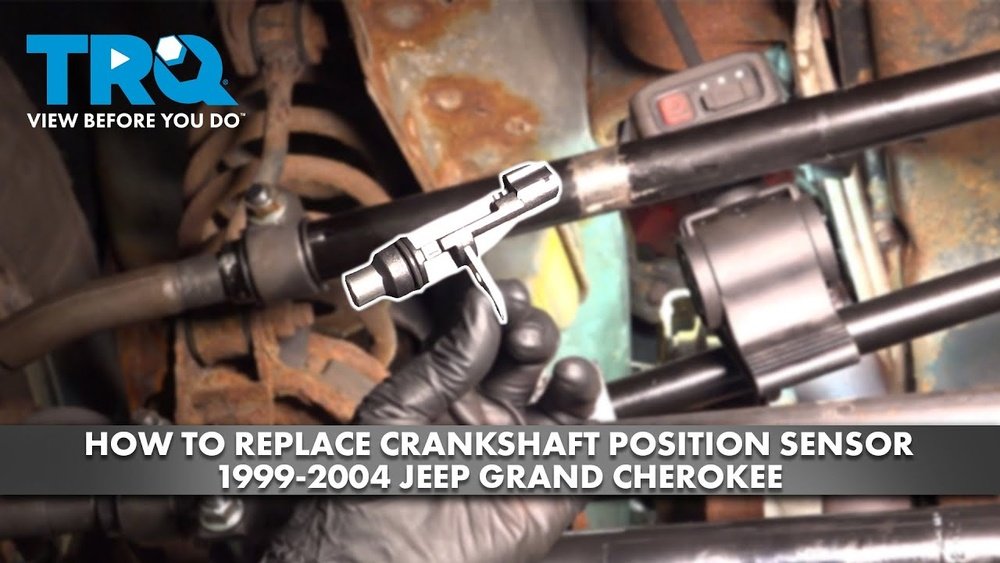
Replacing the crankshaft position sensor on a 2002 Jeep Grand Cherokee is a moderately difficult DIY task. The difficulty largely depends on the sensor’s location and accessibility. In some cases, it’s straightforward; in others, it can be quite challenging due to tight spaces and other components blocking access.
Tools And Parts Needed
- New Crankshaft Position Sensor: Ensure you purchase the correct part for your 2002 Jeep Grand Cherokee. It’s advisable to buy a reputable brand.
- Socket Set and Ratchet: You’ll likely need specific socket sizes to remove the mounting bolt(s) holding the sensor in place.
- Wrench Set: May be needed for certain bolts or to hold components.
- Pliers: For disconnecting electrical connectors or hose clamps if necessary.
- Torque Wrench: To ensure the mounting bolt is tightened to the manufacturer’s specification.
- Penetrating Oil: If the old sensor is seized or difficult to remove.
- Safety Glasses and Gloves: Essential for personal protection.
- Jack and Jack Stands: If you need to lift the vehicle for better access.
- OBD-II Scan Tool: To clear codes after replacement.
Step-by-step Replacement Guide
- Safety First: Park your Jeep on a level surface. Engage the parking brake and chock the wheels. If you need to lift the vehicle, use a jack and secure it with jack stands. Disconnect the negative battery terminal to prevent electrical shorts.
- Locate the Sensor: As mentioned earlier, the CKP sensor is typically located on the driver’s side of the engine block, near the rear. You might need to remove other components like the starter motor, exhaust heat shields, or splash guards to gain clear access. Refer to a service manual for precise location and any necessary component removal steps.
- Disconnect the Electrical Connector: Carefully disconnect the electrical connector from the old CKP sensor. There’s usually a locking tab that needs to be pressed or lifted. Be gentle to avoid breaking the connector.
- Remove the Mounting Bolt(s): Use the appropriate socket and ratchet to remove the bolt(s) securing the CKP sensor. These bolts can sometimes be difficult to reach. If the sensor is seized, apply a small amount of penetrating oil and let it soak for a few minutes.
- Remove the Old Sensor: Once the bolt is removed, gently pull or pry the old sensor out of its mounting hole. It might require some wiggling. Be careful not to damage the mounting surface or the reluctor wheel behind it.
- Install the New Sensor: Clean the mounting hole and ensure the new sensor is the same as the old one. Insert the new CKP sensor into the mounting hole. Make sure it sits flush against the engine block.
- Install the Mounting Bolt(s): Reinstall the mounting bolt(s). Tighten them securely, but do not overtighten. If you have a torque wrench, tighten the bolt to the manufacturer’s specified torque. Overtightening can damage the sensor or threads, while undertightening can lead to vibration and failure.
- Reconnect the Electrical Connector: Plug the electrical connector firmly into the new CKP sensor until it clicks into place.
- Reassemble Removed Components: If you removed any other parts (starter, heat shields, etc. ), reinstall them now.
- Reconnect Battery and Clear Codes: Reconnect the negative battery terminal. Start the engine. It should now start and run smoothly. Use your OBD-II scan tool to clear any stored DTCs, including the P0335 code.
Warning: If the engine still doesn’t start or runs poorly after replacing the sensor, double-check all connections and ensure you purchased the correct part. If the problem persists, there might be an issue with the wiring harness, the ECM, or another related component.
Post-replacement Check
After installation, start the engine and let it run for a few minutes. Listen for any unusual noises and check for smooth operation.
Take your Jeep for a short test drive. Monitor the dashboard for the Check Engine Light.
If it stays off and the engine runs well, the repair is likely successful.

Common Issues And Considerations
When dealing with the crankshaft position sensor on your 2002 Jeep Grand Cherokee, several common issues and considerations can arise, impacting diagnosis and replacement.
Oem Vs. Aftermarket Sensors
Choosing between an Original Equipment Manufacturer (OEM) sensor and an aftermarket one can be a point of debate.
- OEM Sensors: These are made by or for Jeep and are designed to meet the exact specifications of your vehicle. They typically offer the best fit and reliability, but they are often more expensive.
- Aftermarket Sensors: These are made by third-party manufacturers. Quality can vary significantly. Some reputable aftermarket brands produce excellent sensors that perform just as well as OEM. However, cheaper, unbranded sensors can sometimes be unreliable, have poor tolerances, or fail prematurely.
For critical components like the CKP sensor, investing in a quality part, whether OEM or a trusted aftermarket brand, is generally recommended to avoid repeat repairs.
Wiring Harness Issues
It’s crucial to remember that a faulty CKP sensor might not always be the sensor itself. The wiring harness connecting the sensor to the ECM is just as important.
- Corrosion: The connector terminals can corrode over time, especially in humid or salty environments, leading to