Converting your Jeep XJ (Cherokee) from 2-wheel drive (2WD) to 4-wheel drive (4WD) is a project that excites many off-road enthusiasts and practical Jeep owners alike. This transformation gives your vehicle more traction and capability for rough terrain, bad weather, and challenging adventures. However, it’s not as simple as bolting on a few extra parts. The process demands time, mechanical skill, and the right approach. If you’re considering this upgrade, here’s an in-depth, easy-to-understand guide to help you convert your Jeep XJ to 4WD.
Understanding The Basics: Why Convert To 4wd?
The stock 2WD Jeep XJ handles daily driving well, but 4WD offers real advantages. You get improved control on slippery roads, better off-road performance, and higher resale value. The XJ platform is famous for its strength and modification potential, making it one of the most popular SUVs for 4WD swaps. However, before starting, know that the conversion is a significant commitment. It involves replacing or upgrading major components, and skipping steps can lead to unsafe results.
One insight many beginners miss: a 4WD conversion is not only about adding a front axle. It also changes how your suspension, steering, and transmission interact. Planning ahead is crucial.
What You Need For The Conversion
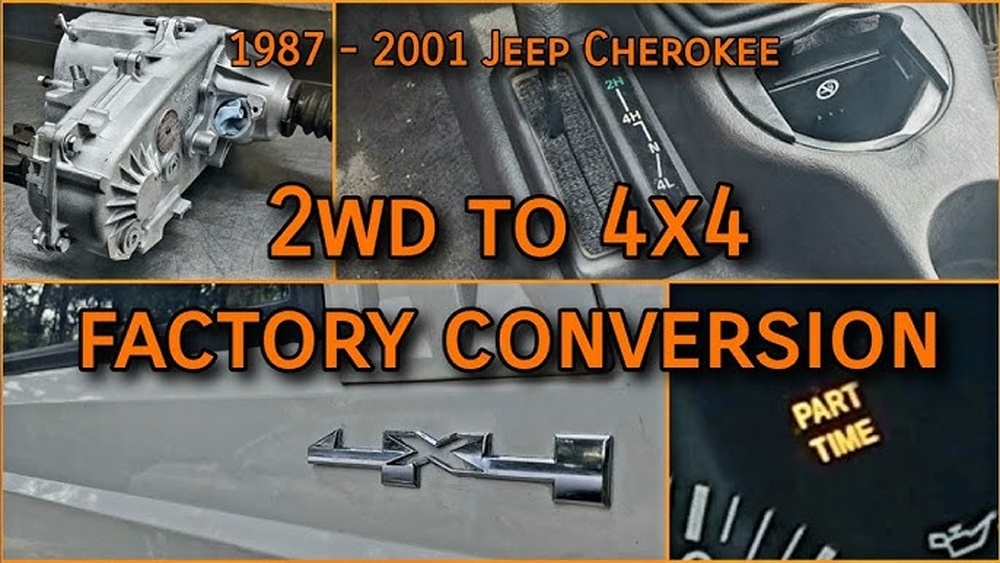
A complete 4WD swap requires more than just a transfer case and driveshaft. Here are the four main components you must address for a safe and reliable conversion:
- Front Axle Assembly
- Transfer Case
- Front Driveshaft
- 4WD Transmission or Adapter
Let’s explore each one in detail.
Front Axle Assembly
The most visible difference between a 2WD and a 4WD XJ is the front axle. In a 2WD model, there’s usually a dummy axle or simply no axle at all. For 4WD, you need a working solid front axle.
Choosing The Right Front Axle
Jeep XJs typically use a Dana 30 front axle. Many 4WD XJs come with a high-pinion Dana 30, which is strong and reliable for most driving needs. You can source a used axle from a salvage yard, parts Jeep, or buy one from an aftermarket supplier.
What’s Involved In Swapping
- Remove 2WD front suspension components and any dummy axle parts.
- Install the Dana 30 with all related hardware: Control arms, coil springs, sway bar links, and track bar.
- Connect the steering linkage and make sure everything is torqued to specification.
- Check the axle’s U-joints and seals. Replace worn parts before installation.
Common Oversights
Some owners forget to check gear ratios. The front and rear axles must match. For example, if your rear axle is 3.55:1, the front must also be 3.55:1. Mismatched gears can destroy your drivetrain.
Example
If you find a front axle from a 1998 XJ with 4. 10 gears, but your 2WD rear axle is 3. 07, you’ll need to re-gear one axle or swap the rear, too.
Transfer Case
The transfer case is the heart of the 4WD system. It sends power to both front and rear axles.
Picking The Right Transfer Case
Most XJ 4WDs use the NP231 or NP242 transfer case. The NP231 is simpler and more common, while the NP242 offers a full-time 4WD mode. The case must match your transmission’s output and the driveshaft yoke.
Installation Steps
- Remove the 2WD tailshaft housing from your transmission.
- Bolt the transfer case onto the transmission output shaft.
- Install transfer case linkage and shifter inside the cabin.
- Wire the 4WD indicator (if desired) to the dashboard.
Key Advice
The transfer case input gear must match your transmission’s spline count (21 or 23 spline, depending on year/engine). Double-check before buying, as the wrong spline count means the parts won’t fit.
Table: Np231 Vs Np242 Quick Comparison
| Transfer Case | Type | Strength | 4WD Modes |
|---|---|---|---|
| NP231 | Part-Time | Good | 2WD, 4HI, 4LO |
| NP242 | Full/Part-Time | Good | 2WD, Full-Time, 4HI, 4LO |
Front Driveshaft
The front driveshaft connects the transfer case to the front axle, delivering power when 4WD is engaged.
Finding The Right Driveshaft
You’ll need a driveshaft that matches the length between your new transfer case and the Dana 30 front axle. Driveshafts from 4WD XJs with the same engine/transmission combo are usually a direct fit.
Installation Tips
- Inspect and replace U-joints as needed.
- Check for proper driveshaft angle to avoid vibration.
- Make sure the driveshaft does not hit the exhaust or suspension at full droop.
Some beginners overlook driveshaft balancing. Even a slightly out-of-balance shaft can cause vibration at highway speed.
4wd Transmission Or Adapter
Your 2WD transmission may not directly accept a transfer case. There are two paths:
Swapping For A 4wd Transmission
A full 4WD transmission has a shorter tailshaft and the correct output for a transfer case. This is the most straightforward method. Used AW4 (automatic) or AX15 (manual) 4WD transmissions from an XJ will fit well.
Using An Adapter Kit
Some opt for an adapter kit to convert their 2WD transmission for 4WD use. These kits add cost but save time if your transmission is in good shape.
Table: Transmission Swap Vs. Adapter Kit
| Method | Pros | Cons |
|---|---|---|
| Swap to 4WD Transmission | Factory fit, reliable, often cheaper used | More labor, may need to swap crossmember/mounts |
| Adapter Kit | Retain existing transmission, less disassembly | Costly, may need professional install |
Other Items Needed
- 4WD shifter assembly and bezel
- Wiring for 4WD indicator light
- Transmission crossmember (may differ between 2WD/4WD)
Step-by-step Process For The Swap
Here’s a simplified overview of the conversion steps:
- Lift and secure the Jeep: Always work on a flat, stable surface with jack stands.
- Remove front suspension and 2WD hardware: Get clear access to the engine bay and undercarriage.
- Install the front axle: Bolt up the Dana 30, connect brakes and steering.
- Swap or adapt the transmission: Remove the 2WD tailshaft, install 4WD unit or adapter.
- Install the transfer case: Bolt up and connect linkage/shifter.
- Fit the front driveshaft: Test for movement and clearance.
- Reconnect everything: Reinstall exhaust, skid plates, and check all bolts.
- Test drive: Start slow; check for leaks, noises, and proper 4WD function.
Practical Tips And Insights
- Collect all parts before starting: Waiting for missing parts mid-project can leave your Jeep undriveable for weeks.
- Label every bolt and wire: This saves confusion during reassembly.
- Check donor parts carefully: Used axles and transfer cases can hide wear. Inspect seals, bearings, and splines before installation.
- Expect hidden costs: Fluids, seals, tools, and unexpected hardware often add $200–$500 to your budget.
A common mistake is ignoring the driveshaft length. Lifts or differences in transmission types can change the ideal driveshaft size. Measure twice before installing.
Cost And Time Estimates
The total cost varies widely. Used parts from a junkyard can keep your budget around $1,000 $1,500. If you buy everything new or pay for labor, the cost can rise to $3,000 or more.
- Parts cost: $800–$2,000
- Labor cost (if not DIY): $800–$1,500
- Time required (DIY): 2–4 full days for experienced mechanics
Some insurance companies may require notification of the conversion due to changed safety and value.
When A 4wd Swap Is (and Isn’t) Worth It
This upgrade makes sense if you want to keep your XJ, love off-roading, or need winter traction. However, if your Jeep is rusty or has a tired engine/transmission, it may be better to buy a factory 4WD XJ.
The swap is a big project, and not all 2WD XJs are worth the investment.
Legal And Safety Considerations
After converting to 4WD, test your Jeep in a safe area before regular driving. Check your local laws; some regions require inspection or registration updates after major modifications. If you’re unsure about any step, consult with a certified mechanic.
For more detailed technical info on Jeep XJ conversions and specifications, the official Jeep Cherokee (XJ) Wikipedia page is a helpful resource.
Frequently Asked Questions
How Hard Is It To Convert A Jeep Xj To 4wd?
The conversion is moderately difficult. You need good mechanical skills, a full set of tools, and plenty of time. The most challenging steps are swapping the front axle and transmission. Many people complete the swap in a weekend with help, but beginners should allow extra time.
Do I Need Special Tools For The Swap?
Basic hand tools cover most steps, but having a transmission jack and impact wrench will make the job easier. Some steps, like pressing in new U-joints or re-gearing axles, may require specialty tools.
Can I Use Parts From Any Year Jeep Xj?
Most 1984–2001 XJ 4WD parts are compatible, but watch for differences in transmission splines, sensor wiring, and front axle style. It’s best to source parts from a Jeep with the same engine and model year range as yours.
Will My Speedometer And Electronics Still Work?
Usually yes, but you may need to swap or adapt the speed sensor from your 2WD to the 4WD transfer case. Most electronics are unaffected, but always check wiring diagrams for your year.
Is It Better To Buy A 4wd Xj Instead?
If you find a clean, rust-free factory 4WD XJ at a good price, it’s often easier and sometimes cheaper than converting your 2WD. However, if your Jeep is in excellent shape or you enjoy projects, the swap is rewarding.
Converting a Jeep XJ to 4WD is a classic project that transforms your vehicle’s capability and value. With careful planning, the right parts, and attention to detail, you’ll enjoy a reliable and trail-ready SUV for years to come.