Jeep is a brand known for its off-road capability and adventure. A big part of this capability comes from its all-wheel drive (AWD) or four-wheel drive (4WD) systems.
These systems help Jeeps grip the road or trail, especially in tough conditions like snow, mud, or sand. But not all Jeeps have the same system, and understanding the differences is key for any Jeep owner or buyer.
Jeep offers a variety of 4WD systems, each designed for different levels of off-road performance. From the basic Command-Trac to the highly capable Rock-Trac and the advanced Selec-Trac, these systems are what give Jeeps their legendary reputation.
This article will explore the different Jeep AWD and 4WD systems, how they work, and which one might be right for you.
We’ll also look at the technology behind them and what makes them stand out.
Understanding Jeep’s 4wd And Awd Systems
Before diving into specific Jeep systems, it’s important to understand the basic difference between all-wheel drive (AWD) and four-wheel drive (4WD). While often used interchangeably, they have distinct characteristics.
AWD systems typically send power to all four wheels all the time or automatically engage the non-driven wheels when slippage is detected. They are generally designed for improved traction on paved roads, especially in wet or slippery conditions like rain or light snow. AWD systems are common in cars and SUVs that prioritize on-road comfort and fuel efficiency, with some off-road capability.
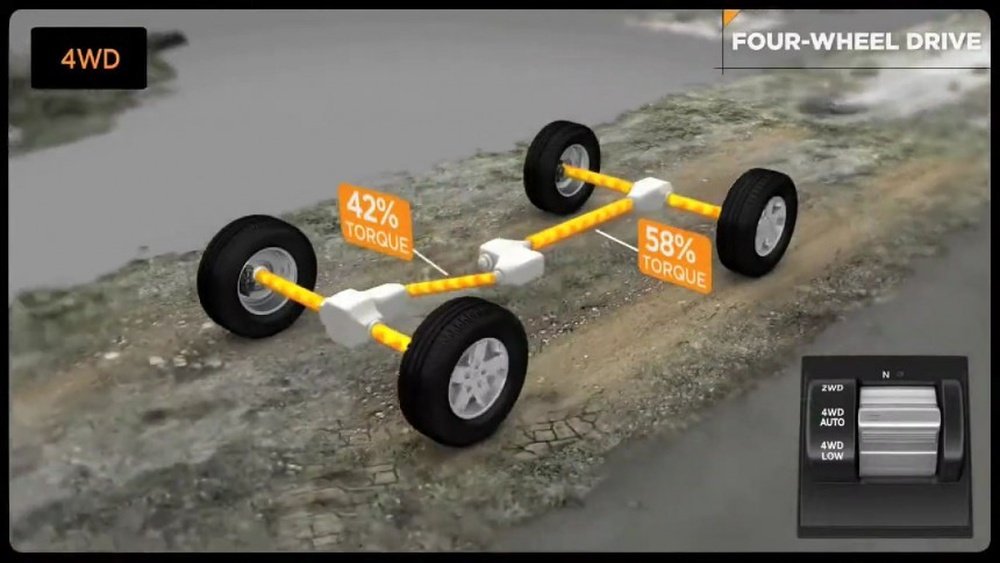
4WD systems, on the other hand, are built for more demanding off-road use. They usually allow the driver to manually select different modes, including a 2WD mode (power to two wheels, typically the rear) for better fuel economy on dry pavement, and various 4WD modes that distribute power to all four wheels. These modes often include a 4WD Low (4L) setting, which provides maximum torque at very low speeds for climbing steep hills, crawling over rocks, or pulling heavy loads.
Jeep primarily uses 4WD systems in its models, with some variations that blur the lines towards AWD for enhanced on-road performance. The core philosophy behind Jeep’s 4WD is to provide drivers with control and confidence in challenging environments.
Jeep’s 4wd System Tiers: Command-trac, Selec-trac, And Rock-trac
Jeep has developed several 4WD systems over the years, each catering to a different level of off-road expertise and requirement. The most common and foundational systems are Command-Trac, Selec-Trac, and Rock-Trac.
Command-trac: The Entry-level 4wd System
The Command-Trac system is Jeep’s most basic and widely available 4WD system. It’s found on models like the Jeep Wrangler Sport and some trims of the Cherokee and Compass. It’s a part-time 4WD system, meaning it’s not designed to be used in 4WD mode on dry, paved roads.
How it works: Command-Trac uses a two-speed transfer case. Drivers can manually shift between three modes using a lever or a rotary dial:
- 2WD High (2H): Power is sent only to the rear wheels. This is the default mode for normal driving on dry pavement, offering the best fuel economy.
- 4WD High (4H): Power is split between the front and rear axles. This mode is for use on slippery surfaces like snow, ice, mud, or gravel. It provides better traction than 2H but should not be used on dry pavement where it can cause driveline binding.
- 4WD Low (4L): This mode engages a lower gear ratio in the transfer case, multiplying engine torque. It’s essential for serious off-roading, such as climbing steep inclines, descending treacherous slopes, rock crawling, or pulling heavy loads at low speeds.
Key Features of Command-Trac:
- Simplicity: Easy to understand and operate.
- Part-time system: Requires driver engagement for 4WD modes.
- Durability: Built to withstand moderate off-road conditions.
Pro Tip: Always shift into 2H when driving on dry, high-traction surfaces. Driving in 4H or 4L on dry pavement can damage the transfer case and driveline components due to the difference in tire speed.
Selec-trac: The Versatile All-weather System
The Selec-Trac system offers more versatility than Command-Trac by incorporating an Automatic 4WD mode. This makes it suitable for a wider range of driving conditions, from everyday commuting to light off-roading, without requiring constant driver input. It’s available on models like the Jeep Grand Cherokee and some Jeep Cherokee trims.
How it works: Selec-Trac also uses a two-speed transfer case but adds a fourth mode:
- 2WD (2H): Similar to Command-Trac, this mode sends power to the rear wheels for normal driving.
- 4WD Auto: This is the key differentiator. In this mode, the system intelligently monitors traction and automatically sends power to the front axle only when needed. This provides the benefits of AWD on-road, enhancing stability in rain or snow, while maintaining rear-wheel drive for better fuel efficiency when traction is not an issue.
- 4WD High (4H): For more aggressive traction, similar to Command-Trac’s 4H mode, but often with a more advanced torque distribution.
- 4WD Low (4L): For maximum off-road torque and capability, identical in function to Command-Trac’s 4L.
Key Features of Selec-Trac:
- Automatic 4WD: Seamlessly transitions between 2WD and 4WD for optimal traction and efficiency.
- All-weather capability: Excellent for drivers who encounter varied weather conditions.
- Comfort and convenience: Less driver intervention needed compared to part-time systems.
In my experience, Selec-Trac provides a great balance. You get the security of 4WD in bad weather without the hassle of constantly switching modes, and it still offers genuine off-road capability when you need it.
Rock-trac: The Ultimate Off-road Machine
The Rock-Trac system is the pinnacle of Jeep’s 4WD technology, designed for extreme off-road performance, particularly for rock crawling. It’s standard on the Jeep Wrangler Rubicon models. This system is built for maximum grip and control in the most challenging terrains.
How it works: Rock-Trac features a heavy-duty, two-speed transfer case with a lower gear ratio (typically 4.0:1) than Command-Trac or Selec-Trac. This provides significantly more torque multiplication in 4L mode. It also comes with Tru-Lok electronic locking differentials on both the front and rear axles.
The modes typically include:
- 2WD (2H): For normal driving.
- 4WD High (4H): For slippery conditions.
- 4WD Low (4L): With its 4.0:1 ratio, this mode delivers immense torque for crawling.
- 4WD Lock (4H Lock / 4L Lock): The Tru-Lok differentials can be electronically locked, forcing both wheels on an axle to rotate at the same speed. This is crucial for rock crawling, as it ensures power is always sent to the wheel with traction, even if the other wheel is in the air or on a slippery surface.
Key Features of Rock-Trac:
- Extreme Off-Road Capability: Designed for rock crawling and the toughest trails.
- Tru-Lok Differentials: Electronically locking front and rear differentials for maximum traction.
- Low Gear Ratio: Deep gearing in 4L for superior torque and control at low speeds.
- Heavy-Duty Components: Built to withstand extreme stresses.
The combination of the low gear ratio and locking differentials makes the Rock-Trac system incredibly effective. It allows the vehicle to maintain momentum and control over obstacles that would stop other 4WD systems.

Advanced Jeep 4wd Systems: Active Drive I, Ii, And Low
Beyond the Wrangler’s core systems, Jeep incorporates more sophisticated AWD and 4WD technologies in its other models, such as the Cherokee, Compass, and Renegade. These systems, often referred to as Jeep Active Drive, are designed to balance on-road refinement with off-road capability.
Jeep Active Drive I
Active Drive I is Jeep’s full-time, single-speed AWD system. It’s designed to provide enhanced traction and stability in various weather conditions, making it suitable for everyday driving.
How it works: Active Drive I constantly monitors traction and automatically distributes torque between the front and rear axles. It does not have a low-range gear setting. If it detects wheel slip, it can send up to 100% of available torque to the axle with the most grip.
Key Features of Active Drive I:
- Full-time AWD: Always engaged for consistent traction.
- Automatic Torque Distribution: Optimizes power delivery based on conditions.
- No driver intervention required: Seamless operation.
- Fuel efficiency: Generally better than traditional 4WD systems due to its lighter weight and design.
This system is a good choice for drivers who want the added security of AWD for everyday driving in areas with frequent rain, snow, or ice, but don’t plan on serious off-roading.
Jeep Active Drive Ii
Active Drive II builds upon Active Drive I by adding a two-speed transfer case, similar to the Selec-Trac system. This upgrade brings genuine low-range capability to Jeep’s more car-like SUVs.
How it works: Active Drive II offers the same full-time AWD capability as Active Drive I but adds a 4WD Low (4L) mode. This mode provides increased torque for tackling steeper inclines, rougher terrain, or when extra pulling power is needed. It also typically includes a Lock mode for the rear axle, further enhancing traction in challenging situations.
Key Features of Active Drive II:
- Two-speed transfer case: Includes a low-range gear for off-road use.
- 4WD Low (4L) mode: Essential for moderate off-road excursions.
- Rear axle lock: Improves traction in slippery conditions.
- Enhanced off-road capability: Bridges the gap between AWD and traditional 4WD.
Active Drive II is a significant step up for models like the Cherokee, offering a more robust solution for those who venture off the beaten path more often but still desire on-road comfort.
Jeep Active Drive Low
Active Drive Low is the most capable version of Jeep’s Active Drive system, found on models like the Jeep Cherokee Trailhawk. It is essentially Active Drive II but with a more aggressive crawl ratio in 4L mode, specifically optimized for off-road crawling.
How it works: Active Drive Low features a two-speed power transfer unit with a lower gear ratio in 4L than Active Drive II. This provides a higher degree of torque multiplication, essential for slow-speed crawling over rocks and uneven terrain. It also includes the locking rear differential.
Key Features of Active Drive Low:
- Aggressive Crawl Ratio: Optimized for rock crawling and extreme low-speed maneuvers.
- Enhanced Off-Road Performance: Designed for Trail Rated capability.
- Full-time AWD with 4WD Low: Combines on-road usability with serious off-road power.
This system is designed to meet Jeep’s Trail Rated standards, signifying its ability to perform in five key off-road categories: traction, water fording, maneuverability, articulation, and ground clearance.
Jeep’s 4wd Technology: Differentials And Traction Control
The effectiveness of any 4WD system relies heavily on how it manages power distribution between the wheels. This is where differentials and advanced traction control systems play a crucial role.
Differentials: The Heart Of Torque Distribution
A differential is a mechanical device that allows the drive wheels on the same axle to rotate at different speeds. This is essential when turning, as the outer wheel needs to travel a greater distance than the inner wheel. However, in off-road situations, a standard open differential can be a weakness.
- Open Differential: In an open differential, torque is always split equally between the two wheels. If one wheel loses traction (e.g., spins freely in the air or on ice), it will receive very little torque, and the wheel with traction will also receive very little torque. This means the vehicle can get stuck even if only one wheel has no grip.
- Limited-Slip Differential (LSD): An LSD provides a compromise. It allows some difference in wheel speed but can also transfer some torque to the wheel with more traction when slippage is detected. This is better than an open differential but not as effective as a locking differential.
- Locking Differential: A locking differential, like Jeep’s Tru-Lok, mechanically connects the two wheels on an axle. When locked, both wheels are forced to rotate at the same speed, regardless of traction. This ensures that power is always sent to the wheel that has grip, making it invaluable for extreme off-roading and rock crawling. Jeep offers electronic versions (Tru-Lok) that can be engaged and disengaged by the driver.
Electronic Traction Control And Stability Systems
Modern Jeeps also incorporate sophisticated electronic traction control (ETC) and electronic stability control (ESC) systems. These systems use sensors to monitor wheel speed, steering angle, and other parameters to detect and correct slippage.
- Traction Control: ETC works by automatically applying the brakes to a spinning wheel or by reducing engine power. This helps to regain traction. In some Jeep systems, ETC can also mimic the function of a limited-slip differential by braking a spinning wheel, allowing torque to be sent to the wheel with traction.
- Electronic Stability Control (ESC): ESC goes a step further by using selective braking and engine power reduction to help the driver maintain control of the vehicle during sudden maneuvers or when traction is lost. It helps to prevent skidding and rollovers.
Jeep’s 4×4 systems are often integrated with these electronic systems to provide a seamless and effective driving experience across various conditions. For example, the Selec-Terrain Management System, found on models like the Grand Cherokee and Wrangler, allows the driver to select different terrain modes (e.g., Auto, Snow, Sport, Mud, Rock) which optimize the AWD/4WD system, throttle response, transmission shift points, and traction control settings for the selected conditions.

Jeep’s 4wd Systems Compared: Which One Is Right For You?
Choosing the right Jeep 4WD system depends on your driving habits, intended use, and the types