Every time you start your Jeep, a series of lights flash on the dashboard. For many drivers, these Jeep light symbols are confusing or even alarming.
Some lights are just reminders, while others warn about serious problems. Knowing what these symbols mean can save you from expensive repairs, help you drive safely, and give you peace of mind on the road.
This guide will walk you through the most common Jeep light symbols, what they mean, and how you should respond. You’ll learn why it’s important not to ignore warning lights, how to tell the difference between urgent and non-urgent alerts, and some practical tips that most new Jeep owners miss.
Whether you drive a Wrangler, Cherokee, Compass, or another model, you’ll be able to decode your dashboard with confidence.
Why Jeep Light Symbols Matter
Modern Jeeps are full of sensors and computers. These systems constantly monitor your engine, brakes, tires, and more. When something needs your attention, a symbol lights up on your dashboard. Some symbols are just informative—for example, telling you the headlights are on. Others, like the check engine light, can mean there’s a serious issue.
Ignoring important dashboard lights can lead to breakdowns, unsafe driving, or even void your warranty. On the other hand, reacting too quickly to harmless lights can cause unnecessary worry and costly trips to the mechanic. Understanding which lights require urgent action helps you make smart decisions.
Categories Of Jeep Light Symbols
Jeep dashboard lights fall into three main categories:
- Warning lights – Urgent problems or safety issues (often red or flashing)
- Indicator lights – Reminders or status information (usually green, blue, or white)
- Malfunction lights – System problems that may affect performance (typically yellow or amber)
Here’s a simple overview:
| Color | Type | Action Needed |
|---|---|---|
| Red | Warning | Stop and check immediately |
| Amber/Yellow | Malfunction | Check soon |
| Green/Blue/White | Indicator | Status or info only |

Common Jeep Light Symbols And Their Meanings
Let’s look at the most common symbols you’ll see in your Jeep.
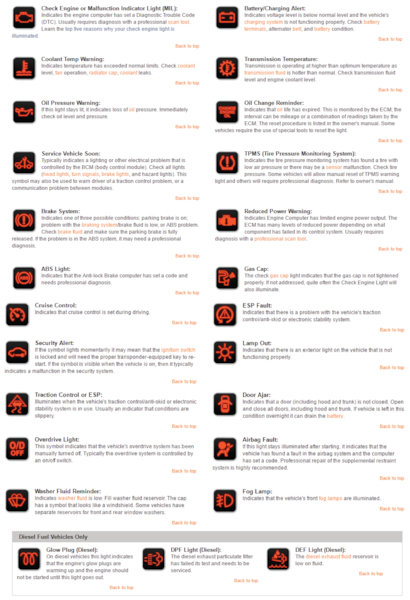
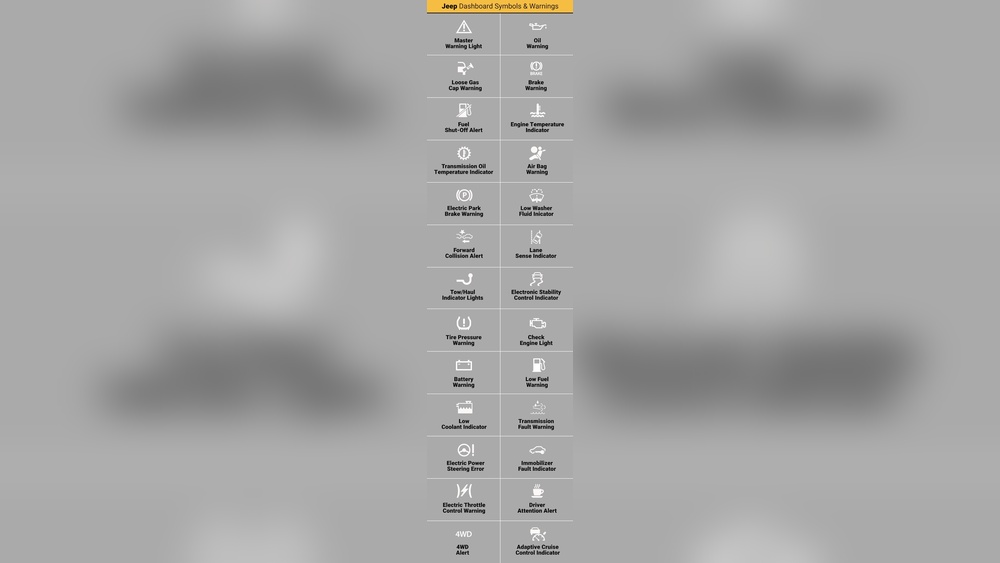
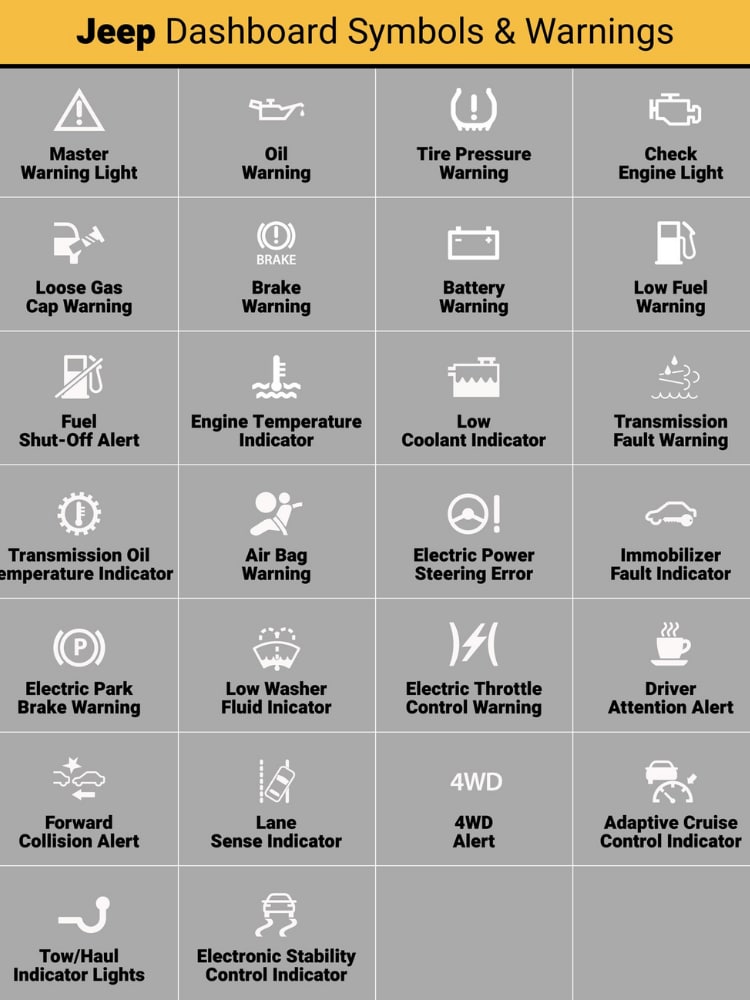
1. Check Engine Light
This engine-shaped symbol is one of the most important. It can mean anything from a loose gas cap to a serious engine problem. If it’s steady, check soon. If it’s flashing, stop driving and get help.
2. Oil Pressure Warning
A red oil can means your engine oil pressure is low. Driving without enough oil can destroy the engine. Stop as soon as it’s safe and check the oil level.
3. Battery/charging Alert
A battery symbol means your Jeep’s charging system isn’t working. The battery might not be charging. If this light comes on, turn off extras like the radio and drive to a mechanic.
4. Tire Pressure Monitoring System (tpms)
An exclamation point inside a horseshoe means one or more tires are low. Low tire pressure can cause poor handling or a blowout. Check and fill your tires soon.
5. Brake Warning
A circle with an exclamation point or the word “BRAKE” means there’s a problem with your brakes, or your parking brake is on. If it stays on after releasing the parking brake, have your brakes checked immediately.
6. Airbag Warning
A person with a circle in front shows your airbag system has a problem. Airbags might not work in a crash. Get this checked as soon as possible.
7. Abs Warning
The letters “ABS” in a circle mean your anti-lock brakes aren’t working. Your Jeep can still stop, but the wheels might lock in hard braking. Repair this soon.
8. Coolant Temperature Warning
A red thermometer means your engine is overheating. Pull over, turn off the engine, and let it cool before opening the hood.
9. Transmission Temperature Warning
A gear symbol with a thermometer signals your transmission is too hot. Stop and let the Jeep cool. Driving with an overheated transmission can cause major damage.
10. Seat Belt Reminder
A person with a seatbelt means someone isn’t buckled up. Always wear your seatbelt for safety.
11. Door Ajar
A car with open doors means one or more doors aren’t fully closed. This can be dangerous while driving.
12. Low Fuel Indicator
A yellow gas pump means you’re running low on fuel. Refuel soon to avoid running out.
13. Cruise Control Indicator
A speedometer with an arrow shows cruise control is active.
14. High Beam Indicator
A blue headlight symbol shows your high beams are on.
15. Turn Signal Indicators
Green arrows point left or right to show your turn signals are on.
These are the most common, but your Jeep may have other symbols depending on the model and year.
Less-known Jeep Symbols That Matter
Some Jeep symbols are easy to miss, but they’re important for long-term care.
Electronic Stability Control (esc)
A car with wavy lines behind it means the ESC system is working to keep you stable. If the light stays on, the system isn’t working—helpful in slippery conditions.
4wd Indicator
A car with “4×4” tells you when four-wheel drive is engaged. If it flashes, there may be a problem with the 4WD system.
Lane Departure Warning
A car crossing dashed lines alerts you when you’re drifting out of your lane. If it stays on, clean your sensors or check the system.
Adaptive Cruise Control (acc)
A car with a gauge and lines in front means adaptive cruise is watching the distance to the car ahead. If it blinks, the sensor may be blocked by dirt or snow.
Auto Start-stop Indicator
A circular arrow with an “A” shows the auto start-stop function is working. If it flashes, the system is off or has a problem.
What To Do When A Light Comes On
When you see a dashboard light, here’s a step-by-step approach:
- Check the color—Red means urgent. Amber/yellow means caution. Green/blue/white is usually just information.
- Read the symbol—Try to match the symbol with your owner’s manual. Some Jeeps also display messages with the symbol.
- Respond appropriately—For red lights, pull over safely. For yellow lights, schedule service soon. For green/blue lights, just be aware.
- Don’t ignore persistent lights—If a light stays on after starting, it needs attention. Ignoring it can lead to bigger problems.
- Resetting after repairs—Sometimes, the light stays on even after fixing the problem. You may need a scan tool or a few drive cycles to reset it.
How Jeep Light Symbols Differ From Other Cars
Jeep uses many universal symbols, but some are unique or behave differently. For example, Jeep’s off-road features have their own symbols, such as sway bar disconnect or hill descent control. Also, TPMS can be more sensitive on Jeep SUVs with larger tires.
Here’s a comparison between Jeep and a typical sedan:
| Feature | Jeep Symbol | Sedan Symbol | Notes |
|---|---|---|---|
| 4WD System | “4×4” icon | Not available | Unique to Jeep/SUVs |
| Hill Descent | Car on slope | Not available | Off-road feature |
| TPMS | Horseshoe/exclamation | Same | More sensitive in Jeeps |
| Oil Pressure | Red oil can | Red oil can | Standard symbol |
Two Insights Jeep Owners Often Miss
- Some warning lights come on during extreme weather—For example, the TPMS light can appear during cold mornings because tire pressure drops in low temperatures. If you top up your tires and the light stays on, check for a slow leak or a faulty sensor.
- Aftermarket accessories can trigger lights—Adding non-standard wheels, lights, or lifts can confuse your Jeep’s electronics. This may cause warning lights to come on, even if nothing is actually wrong. Always use Jeep-approved parts when possible.
When Should You Visit A Mechanic?
Not every light means you have to rush to the shop, but some do. Visit a mechanic if:
- A red light stays on after starting
- The check engine light is flashing
- The same warning light keeps coming back after resets
- Multiple warning lights come on at once
- Your Jeep is driving differently (noises, shaking, loss of power)
For less urgent lights (like the yellow check engine), you can use an OBD2 scanner to read the codes. This device plugs into your Jeep and tells you why the light is on. However, some codes require professional help.
Resetting Jeep Light Symbols
After you fix a problem, most warning lights turn off after a few drive cycles. If not, you may need to:
- Disconnect the battery for a few minutes (not always recommended, as it can reset radio and clock)
- Use an OBD2 scanner to clear codes
- Visit a Jeep dealer for a software reset
Remember, resetting a light without fixing the problem is never a good idea. The warning will just come back.
Practical Tips For Managing Dashboard Lights
- Always carry your owner’s manual—It has a full list of symbols.
- Keep a tire gauge and small air compressor in your Jeep. This helps you respond quickly if the TPMS light comes on.
- Pay attention to new or unusual lights—If you see a symbol you don’t recognize, look it up right away.
- Consider a dashboard camera—If a light comes on right before an incident, a dashcam can help document what happened.
- Don’t rely only on color—A yellow or green light can still mean a feature isn’t working, which may be important for off-roading.
Jeep Light Symbols And Safety
Dashboard lights are about more than convenience—they’re a key part of your Jeep’s safety system. For example, the airbag and ABS lights warn you when critical safety features aren’t working. Ignoring these could put you at risk in a crash.
A recent study by the National Highway Traffic Safety Administration found that nearly 1 in 5 drivers ignore dashboard warning lights for more than a week. This increases the chance of breakdowns and accidents. Always treat warning lights with respect.
For more details about safety-related dashboard lights, check the official NHTSA Road Safety resource.
Frequently Asked Questions
<!– wp:rank-math/faq-block {"questions":[{"id":"faq-question-b6038d677955","title":"What Does A Flashing Check Engine Light Mean In My Jeep?","content":"A flashing check engine light means there’s a serious problem, often a misfire that could damage your engine. Stop driving and have your Jeep checked by a mechanic immediately.
“,”visible”:true},{“id”:”faq-question-a1a40b418bda”,”title”:”Can I Drive With The Tire Pressure Light On?”,”content”:”If the TPMS light is on, check your tire pressure as soon as possible. Driving with low tire pressure is unsafe, especially at high speeds. It’s usually safe to drive a short distance to fill your tires, but don’t ignore the light.
“,”visible”:true},{“id”:”faq-question-36fcb08fdb4f”,”title”:”Why Do Some Warning Lights Come On When I Start My Jeep But Then Turn Off?”,”content”:”Many lights come on for a few seconds when you start your Jeep. This is normal—your Jeep is doing a system check. If they turn off quickly, everything is working correctly. If a light stays on, it needs attention.
“,”visible”:true},{“id”:”faq-question-b7c61dc8a87a”,”title”:”How Do I Reset A Dashboard Warning Light?”,”content”:”Most lights reset automatically after fixing the problem. If not, you can use an OBD2 scanner or visit a mechanic for help. Never just reset a light without fixing the underlying issue.
“,”visible”:true},{“id”:”faq-question-14bffb2223f7″,”title”:”Are Jeep Dashboard Symbols The Same In All Jeep Models?”,”content”:”Most symbols are similar across Jeep models, but a few differ—especially for special features like 4WD or off-road tools. Always refer to your owner’s manual for the exact meanings.
Understanding your Jeep light symbols is one of the easiest ways to prevent costly repairs and drive with confidence. Don’t ignore your dashboard—treat it as your first line of defense for safe, smooth driving. If you’re ever unsure, check your manual or ask a Jeep specialist.
With a bit of knowledge, you can enjoy your Jeep adventures without unwanted surprises.
“,”visible”:true}]} –>What Does A Flashing Check Engine Light Mean In My Jeep?
A flashing check engine light means there’s a serious problem, often a misfire that could damage your engine. Stop driving and have your Jeep checked by a mechanic immediately.
Can I Drive With The Tire Pressure Light On?
If the TPMS light is on, check your tire pressure as soon as possible. Driving with low tire pressure is unsafe, especially at high speeds. It’s usually safe to drive a short distance to fill your tires, but don’t ignore the light.
Why Do Some Warning Lights Come On When I Start My Jeep But Then Turn Off?
Many lights come on for a few seconds when you start your Jeep. This is normal—your Jeep is doing a system check. If they turn off quickly, everything is working correctly. If a light stays on, it needs attention.
How Do I Reset A Dashboard Warning Light?
Most lights reset automatically after fixing the problem. If not, you can use an OBD2 scanner or visit a mechanic for help. Never just reset a light without fixing the underlying issue.
Are Jeep Dashboard Symbols The Same In All Jeep Models?
Most symbols are similar across Jeep models, but a few differ—especially for special features like 4WD or off-road tools. Always refer to your owner’s manual for the exact meanings.
Understanding your Jeep light symbols is one of the easiest ways to prevent costly repairs and drive with confidence. Don’t ignore your dashboard—treat it as your first line of defense for safe, smooth driving. If you’re ever unsure, check your manual or ask a Jeep specialist.
With a bit of knowledge, you can enjoy your Jeep adventures without unwanted surprises.